
If a competitor holds a weak or wrongfully granted patent that is blocking your business, patent invalidation in China is the legal mechanism designed to remove it.
Any person or company can file a request with the China National Intellectual Property Administration (CNIPA) at any time after a patent is granted.
Understanding the grounds, process, and strategy behind a successful challenge is essential for companies seeking to clear the market and for patent owners preparing to defend their rights.
This guide covers everything you need to know.
What Is Patent Invalidation in China?
Patent invalidation is a formal legal process through which any party can request CNIPA to declare a granted patent void.
The system exists to protect the public from improperly granted patents that block innovation, restrict competition, or were filed dishonestly.
A key feature of the Chinese system is its openness: you do not need to be a defendant in an infringement lawsuit to file a request.
A competitor can proactively challenge a patent it believes is weak, even before any lawsuit is filed. This makes invalidation a powerful strategic tool in the Chinese market.
Who Can File and When

Any natural person, company, or organization with civil litigation standing can file a request. The patent owner can even file against their own patent to narrow its scope. There is no deadline.
Requests can be filed at any point during the life of a patent, and even after a patent has expired or been abandoned, with one exception: patents abandoned from the date of filing cannot be challenged.
In practice, the most common scenario is an accused infringer filing an invalidation request immediately after being sued.
A party typically files a simplified request first to obtain a "Notification of Acceptance" from CNIPA, which can trigger a suspension of the infringement lawsuit. They then have one month to submit complete grounds and detailed evidence.
Valid Grounds for Patent Invalidation
Not every argument works. CNIPA recognizes specific statutory grounds. The table below organizes these by how frequently they are used in practice.
The Step-by-Step Invalidation Process
The entire proceeding is managed by CNIPA. It moves through three formal stages, each with its own rules and deadlines.
One important note on evidence: the petitioner must submit all key evidence within the first month. Evidence added after this window will generally be rejected, except for counterevidence responding to the patent owner's own submissions.
What Happens After the Decision
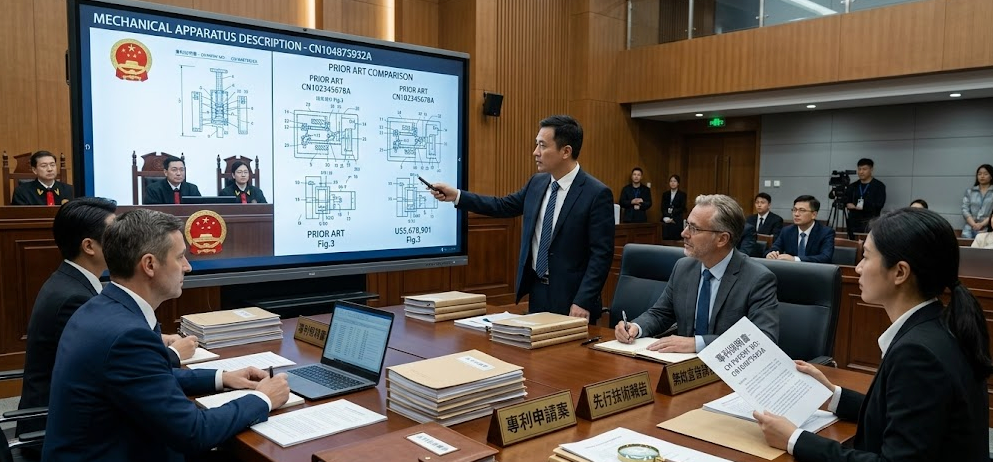
CNIPA issues one of three outcomes: the patent is declared fully invalid, partially invalid (with some claims surviving), or fully maintained.
A patent declared invalid is treated as if it never existed. This means ongoing infringement lawsuits based on that patent will likely be dismissed.
However, the decision does not have a retroactive effect on court judgments that have already been enforced or on previously paid licensing fees, unless the patent owner acted in bad faith.
Any party unhappy with the outcome can appeal to the Beijing Intellectual Property Court within three months.
The court reviews both procedural and factual issues. In 2023, the court overturned approximately 3.8% of CNIPA's invalidation decisions at first instance, indicating the bar to overturning CNIPA is high.
A further appeal to the Intellectual Property Court of the Supreme People's Court is available for second-instance review, with the second-instance judgment being final.
How Patent Owners Can Defend Against Invalidation
Receiving an invalidation request is serious, but patent owners have real tools to fight back. The key is speed and precision.
Amend Your Claims Strategically
Patent owners of invention and utility model patents can amend their claims upon receiving CNIPA's acceptance notification.
However, the rules are strict. Permitted amendments are limited to four specific actions:
- deleting a claim entirely
- removing one technical solution from a claim covering multiple solutions
- further narrowing a claim by adding features from other granted claims
- correcting obvious errors.
You cannot add new subject matter, expand the protection scope, or introduce technical features that were not in the original granted claims.
Design patent owners have no right to amend their patent documents at all during this process.
Prepare Strong Prior Art Counterevidence
If the challenge relies on prior art, the patent owner can submit evidence that the cited prior art does not actually anticipate the claims.
Technical expert declarations and product test results are often useful. Common knowledge evidence can be submitted by either party right up until the oral hearing closes.
👉 For a broader perspective on protecting your IP position once a challenge is underway, review our guide on Intellectual Property Protection in China.
Special Rules for Utility Model Patents
Utility model patents are treated differently from invention patents in two important ways during invalidation.
First, when assessing inventive step, CNIPA focuses only on the technical field to which the utility model belongs, whereas invention patents are assessed across related and broader technical fields.
Second, only one or two prior art references can normally be cited against a utility model's inventiveness, compared to three or more for invention patents.
This makes utility models somewhat easier to defend in an invalidation proceeding, but also somewhat easier to invalidate with strong, directly relevant prior art in the same technical field.
Tips for Foreign Companies Filing or Defending

Foreign businesses face an additional layer of complexity: all official documents must be in Chinese, and foreign petitioners must provide a notarized certificate of incorporation issued by a local notary.
Practical steps for foreign parties:
- Engage a Chinese IP attorney with CNIPA experience before you file, not after
- Prepare a complete, detailed invalidation request from the start rather than filing a bare-bones version
- If you are a patent owner, monitor your competitors' market activity and CNIPA filings so threats are not a surprise
- Keep all prior art searches, technical comparisons, and internal documents organized in case a challenge arises
- If defending, respond to CNIPA's notification immediately and do not miss the one-month window to amend claims
👉 Our guides on China Patent Infringement and How to Protect Your IP in China provide additional context on building a complete enforcement and defense strategy.
Conclusion
Patent invalidation in China is a highly structured, time-sensitive legal process with real strategic value for businesses on both sides of a patent dispute.
The CNIPA system processed close to 9,000 requests in 2023 alone, underscoring the centrality of this mechanism in Chinese IP practice.
Whether you are challenging a patent that is blocking your operations or defending rights you have worked hard to secure, the outcome depends heavily on preparation, timing, and the quality of your evidence.
Starting with a thorough legal analysis of your position before filing or responding is the single most important step you can take.
For further reading, explore our resources on IP Protection Clauses in Chinese Contracts and Intellectual Property Lawyers in China.
FAQs About Patent Invalidation in China
Who can file a patent invalidation request in China?
Any person, company, or organization, including competitors, accused infringers, and even the patent owner themselves, can file a request with CNIPA. There is no standing requirement tied to a lawsuit. The only condition is that the patent must have been formally granted by CNIPA.
Is there a time limit for filing a patent invalidation request in China?
No. A request can be filed at any time after a patent is granted, including after the patent has expired or been abandoned. The only exception is patents that were abandoned at the time of filing, which cannot be challenged. This unlimited window makes invalidation a flexible long-term strategic option.
How long does the patent invalidation process take in China?
From the date of filing the request to receiving the examination decision, the process typically takes 6 to 10 months. Complex cases involving multiple claims or disputed technical facts can take over a year. An appeal to the Beijing Intellectual Property Court adds another 6 to 12 months on top of that.
What are the three possible outcomes of a CNIPA invalidation decision?
CNIPA can declare the patent invalid in full, declare it invalid in part (with some claims surviving in original or amended form), or maintain the full validity of the patent as granted. Either party may appeal the outcome to the Beijing Intellectual Property Court within three months of receiving the decision.
Do patent laws exist in China?
Yes, China has strong patent laws that protect inventions, designs, and utility models. These laws are enforced by courts and government agencies. Patent owners can take legal action if someone uses their invention without permission. China’s patent system is similar to other major countries and supports innovation and business protection.
Subscribe to receive updates
Subscribe to receive the latest blog posts to your inbox every week.