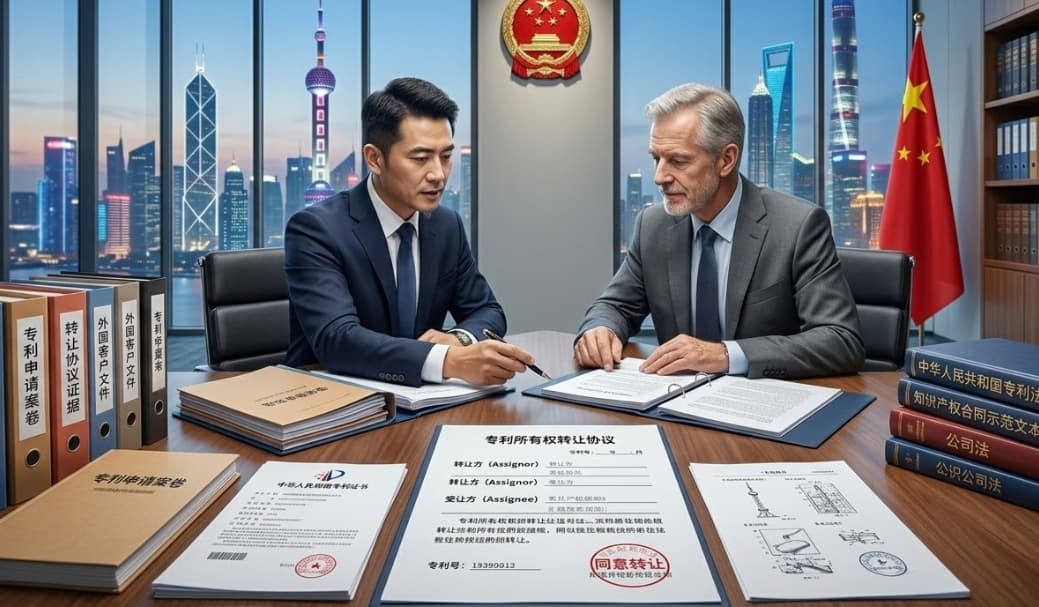
Whether you are selling a business, restructuring a corporate group, or assigning technology rights to a foreign entity.
Understanding patent ownership transfer in China is non-negotiable, and getting a qualified China patent lawyer involved early can be the difference between a smooth transfer and a legally ineffective one.
China's patent assignment process involves CNIPA registration, written contracts, MOFCOM clearance for foreign-bound transfers, and, in some cases, export control compliance.
This guide covers every step, every requirement, and every risk that foreign companies must know in 2026.
What Is Patent Ownership Transfer in China?
Patent ownership transfer in China, also called a patent assignment, is the permanent transfer of all rights in a granted patent or pending patent application from one party (the assignor) to another (the assignee).
Under Article 10 of China’s Patent Law, a valid patent assignment requires:
- A written assignment contract
- Recordal with CNIPA (China National Intellectual Property Administration)
- Registration and publication by CNIPA
The assignment becomes legally effective only after CNIPA completes registration.
Assignment vs License
A patent assignment is different from a patent license:
- Patent assignment: Transfers full ownership permanently, including the right to enforce, license, or transfer the patent
- Patent license: Grants permission to use the patent, but ownership remains with the original patent holder
Additional requirements for foreign companies
If the assignment involves a foreign entity, additional regulatory requirements may apply, including:
- Compliance with China’s technology import and export regulations
- Possible technology export review or approval, depending on the technology category
- Registration with relevant government authorities when required
These requirements help ensure compliance with China’s export control and technology transfer laws.
Step-by-Step: How to Transfer Patent Ownership in China

Step 1: Conduct Due Diligence
Before signing, verify the patent’s legal status through CNIPA:
- Confirm the patent is valid and in force (maintenance fees paid)
- Check for pledges, liens, or security interests
- Review any pending invalidation or litigation
- Confirm the assignor is the registered legal owner
This helps prevent the transfer of an invalid or restricted patent.
Step 2: Draft and Sign the Assignment Agreement
China requires a written patent assignment contract.
The agreement should include:
- Patent number and title
- Full legal names and addresses of both parties
- Transfer terms and consideration
- Scope of transferred rights
- Signatures of both parties
For foreign-related transfers, a Chinese-language version is strongly recommended, as CNIPA recordal is conducted in Chinese.
Step 3: Comply with Technology Transfer and Export Regulations (If Foreign Party Involved)
If the transfer involves a foreign entity:
- The transaction may require technology import/export registration
- Some technologies require an export license under China’s export control rules
- Compliance depends on whether the technology is restricted, prohibited, or freely transferable
These requirements are regulated by the Chinese technology export and foreign exchange authorities.
Step 4: Submit Recordal to CNIPA
To complete the assignment, submit the following to CNIPA:
- Assignment recordal application form
- Signed patent assignment agreement
- Consent from co-owners (if applicable)
- Power of attorney (if using a patent agent)
- Government fees
CNIPA does not examine the commercial terms but verifies formal compliance.
Step 5: CNIPA Registration and Publication
CNIPA reviews the documents and, if approved:
- Registers the new patent owner
- Publishes the ownership change in the official patent register
The assignment becomes legally effective only after CNIPA registration and publication.
📌 Important Note: Patent ownership transfer in China is not complete until it is officially recorded with CNIPA. Without recordal, the transfer is not enforceable against third parties.
Table 1: Required Documents at a Glance
Why a China Patent Lawyer Is Essential

Patent assignments in China, especially cross-border transfers, involve strict legal, regulatory, and procedural requirements. A qualified China patent lawyer helps ensure the transfer is valid, enforceable, and compliant.
Key reasons to work with a China patent lawyer
1. Drafting a compliant assignment agreement
- Ensures the contract meets China Patent Law and CNIPA recordal requirements
- Avoids errors common in foreign templates that may delay or invalidate the transfer
- Ensures enforceability under Chinese law
2. Handling export control and technology transfer compliance
- Determines whether the technology requires export registration or approval
- Ensures compliance with China’s technology import/export regulations
- Helps prevent delays, rejection, or regulatory penalties
3. Managing CNIPA recordal procedures
- Prepares and submits all required documents correctly
- Ensures smooth processing and faster registration
- Avoids procedural mistakes that can delay ownership transfer
4. Conducting legal due diligence
- Verifies patent ownership and legal status
- Checks for pledges, co-owners, disputes, or invalidation risks
- Protects the buyer from acquiring defective or disputed rights
5. Coordinating complex or multi-patent transfers
- Manages portfolio transfers during M&A, licensing, or restructuring
- Ensures proper registration across multiple patents
- Maintains legal consistency across all assignments
A Chinese patent lawyer ensures the assignment complies with Chinese law, avoids regulatory risks, and protects the validity and enforceability of the transferred patent rights.
Common Mistakes to Avoid 🙅🏻♀️
Foreign companies making their first Chinese patent assignment frequently encounter the same costly errors:
- Assuming the signed contract transfers ownership. Under Chinese law, registration with CNIPA is the trigger for legal effectiveness. A signed but unregistered assignment is void against third parties and unenforceable in most disputes.
- Skipping the MOFCOM step. Many foreign buyers and sellers learn about the MOFCOM registration requirement only after submitting to CNIPA and receiving a rejection. This delays the transfer by months.
- Using a standard Western NDA or assignment template. Chinese IP courts and CNIPA apply Chinese law standards. Contracts not drafted or reviewed in accordance with Chinese law often fail to meet evidentiary and procedural requirements.
- Failing to get the co-owner's consent. If a patent is jointly owned and one co-owner's written consent is missing, CNIPA will reject the application. This is a frequent issue in JV dissolution or corporate restructuring scenarios.
- Not accounting for export control. China's Export Control Law (2020) applies to patent assignments involving controlled technologies. Companies that proceed without proper clearance face criminal exposure and the assignment itself may be voided by authorities.
Conclusion
Patent ownership transfer in China is a multi-step, legally demanding process that goes well beyond signing an assignment contract.
CNIPA recordal, MOFCOM registration for foreign-bound transfers, export control compliance, co-owner consent, and proper contract drafting under Chinese law are all mandatory elements.
Missing any one of these steps can result in a rejected filing, an unenforceable assignment, regulatory penalties, or, in serious cases, criminal liability.
For foreign companies handling a patent transfer in China, working with an experienced China patent lawyer from the beginning is not optional.
It is the only way to ensure the assignment is valid, enforceable, and completed without costly delays.
FAQs About Patent Ownership Transfer in China
Can you own a patent in China?
Yes, individuals and companies, including foreigners, can own a patent in China. You must file a patent application with the China National Intellectual Property Administration (CNIPA) and meet all legal requirements. Once granted, the patent owner has exclusive rights to use, license, or sell the invention in China. This legal protection helps prevent others from using the invention without permission.
How does property ownership work in China?
In China, individuals and companies cannot own land, but they can own property built on the land. Land is owned by the state or collectives, and property owners receive land-use rights for a set number of years. These rights can usually be sold, transferred, or inherited. This system allows legal control and use of the property.
How do I transfer ownership of a patent?
To transfer ownership of a patent, you must sign a patent assignment agreement between the current owner and the new owner. This legal document confirms the transfer of rights. You must also register the transfer with the China National Intellectual Property Administration (CNIPA) for it to be valid in China. Once approved, the new owner gains full legal control of the patent.
What is the All-China Patent Attorneys Association?
The All-China Patent Attorneys Association (ACPAA) is the official organization that represents licensed patent attorneys in China. It helps regulate professional standards and supports patent legal services. The association also provides training and guidance to ensure quality patent representation. It plays an important role in protecting intellectual property rights in China.
Do I need a lawyer to transfer a patent in China?
While it is technically possible for domestic entities to file the paperwork themselves, foreign companies and individuals without a registered office in mainland China are legally required to use a licensed Chinese patent agency to handle CNIPA procedures. Beyond the mandatory filing rules, a lawyer is essential to draft an enforceable contract and navigate technology export laws safely.
Subscribe to receive updates
Subscribe to receive the latest blog posts to your inbox every week.