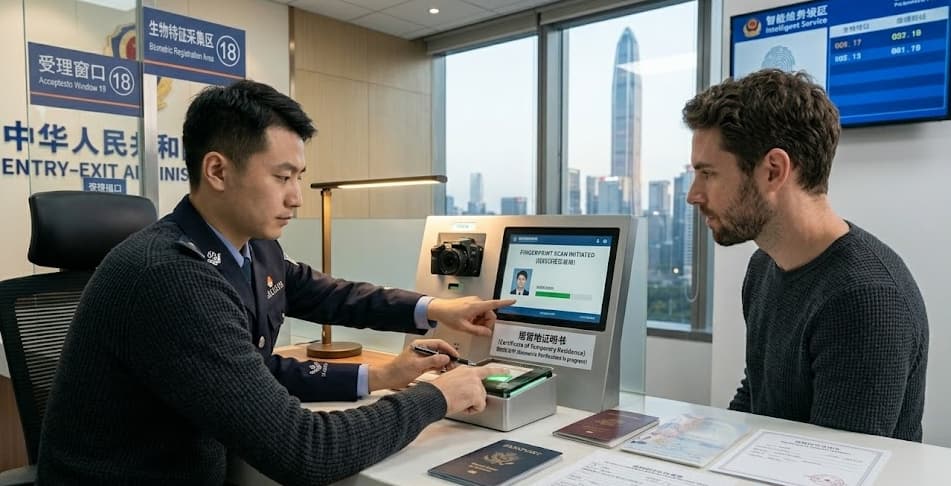
One of the most overlooked legal obligations for foreigners arriving in China is the registration for a temporary residence permit in China.
Under Chinese immigration law, this is not optional, and it is not limited to long-term residents: it applies to everyone, from a tourist staying with a friend for a few nights to an expat executive moving into a new apartment.
Failing to register carries financial penalties and, increasingly in 2026, affects the outcomes of visa and residence permit renewals.
This guide explains exactly who must register, when, how, what documents to bring, and what the TRRF is used for.
What Is the China Temporary Residence Registration?

The term "temporary residence permit" in the context of Chinese immigration most commonly refers to the Temporary Residence Registration Form (TRRF). It is sometimes called:
- Accommodation Registration Form
- Registration Form for Temporary Residence
- Registration Voucher of Residence for Visitors from Overseas
- 临时住宿登记表 (Chinese)
According to China's Exit-Entry Administration Law, if you are a foreign national or a resident of Hong Kong, Macau, or Taiwan, you need to register with a hotel or a local police station within 24 hours of arriving in China. After you register, the police station or hotel will give you a Temporary Residence Registration Form (TRRF).
The form records your name, passport number, visa type, accommodation address, and the period covered. It serves as official proof that you have complied with China's residence reporting obligations.
The Legal Basis: Articles 39 and 76
The requirement stems directly from the Exit and Entry Administration Law of the People's Republic of China, which took effect on July 1, 2013.
- Article 39 states: "If a foreigner stays in a hotel in China, the hotel shall register their accommodation according to public security management provisions for hotels, and report accommodation registration information of the foreigner to local public security organs.
If a foreigner resides or stays in a dwelling place other than a hotel, they or the persons who accommodate them shall, within 24 hours after the foreigner's arrival at that dwelling place, go through the registration formalities with the public security organs in the place of residence."
- The penalty for non-compliance is set in Article 76: a warning shall be given and a fine of not more than CNY 2,000 may also be imposed on foreigners who reside or stay in lodgings other than hotels but fail to go through registration formalities in accordance with the provisions in Article 39.
Beyond the direct financial penalty, failure to register creates a gap in the public security record that can block your access to other essential services.
Who Must Register and When?
Everyone, regardless of visa type
The registration requirement applies to all foreign nationals in China regardless of how they entered: on a tourist visa, a work visa, a student visa, visa-free, or on transit. It applies from day one.
The 24-hour deadline
In most urban areas, registration is expected within 24 hours after you move into the accommodation. In some rural areas, the time limit may be longer, such as up to 72 hours, depending on local practice.
The 24-hour clock starts when you arrive at the accommodation, not when you enter China. If you arrive in Shanghai at midnight and go directly to a hotel, the hotel handles registration.
If you then move to an apartment the following afternoon, you have 24 hours from your move-in time to register at the police station.
When you must re-register
You are required to re-register in each of the following situations:
- Every time you move to a new non-hotel address, even within the same city
- Every time you re-enter China on a visa (the existing registration does not automatically extend)
- Every time you check into a new hotel (handled automatically by the hotel)
- When you move between cities and stay in private accommodation
For persons with a visa, they should register after each move to a new place within China (hotel, apartment, or otherwise) and each time they return to a place from abroad. For persons holding a valid, unexpired residence permit, the answer is not so clear at the national level, and local rules differ.
Two Situations: Hotel vs. Private Accommodation
If you are staying at a licensed hotel, guesthouse, or hostel
When staying at a hotel or other paid accommodation, such as guesthouses, hostels, or serviced apartments, the hotel staff will handle the registration on your behalf.
You will only need to provide your passport or another travel document that contains the visa you used to enter China, or your current residence permit.
The hotel submits your information electronically to the local PSB. You should request a stamped copy of the TRRF from reception when you check in, as you may need it later for government applications.
Note on short-term rentals (Airbnb and similar): A paid home-share arrangement such as Airbnb is not covered by the hotel registration system.
Even if the platform looks like a hotel, if the property is not a formally licensed hotel registered with the public security system, you must register yourself at the local police station.
If you are staying in private accommodation
This covers renting an apartment, staying with friends or family, living in a university dormitory, or residing in a company-provided dormitory.
Foreigners who stay elsewhere need to register their residence at the local police station within 24 hours upon arrival.
They can do so by presenting a valid passport or other international travel document, along with the rental contract or property ownership certificate.
Your landlord or host can also register on your behalf or accompany you to the police station.
Some universities and employers register their foreign students and staff collectively, though not all inform the individual that this has been done.
Step-by-Step: How to Register at the Police Station
Step 1: Identify your local police station
Go to the派出所 (pàichūsuǒ), the neighborhood police station closest to your accommodation address. This is not the same as the PSB Exit-Entry Administration office where you apply for residence permits. These are separate offices.
Step 2: Prepare your documents
The core documents required are:
- Original passport (officers must verify in person; copies alone are typically not sufficient)
- Entry visa or residence permit page
- China entry stamp pages from your passport
- Proof of accommodation address: rental contract, property deed, or a letter from your host or employer
Additional documents that may be requested (varies by city):
- A copy of the host's Chinese national ID card (if staying with a Chinese national)
- A copy of the host's hukou (household registration booklet) if the address does not appear on their ID
- 1 to 2 passport-sized photographs (some cities)
- A letter from your employer or school (for certain cities or districts)
Step 3: Complete the registration form and collect your TRRF
The police station will provide or complete the registration form. After processing, you will receive the TRRF stamped with the police station's seal. Keep the original. Scan or photograph it immediately as a backup.
Step 4: Scan and store your TRRF
Schools or employers often do the registration on behalf of their foreign students or foreign employees, sometimes without informing them properly. If someone else registers on your behalf, ask them to provide you with the original TRRF. You will need it for future applications.
What the TRRF Is Used For
The TRRF is not simply a bureaucratic formality. It is a document that the PSB uses to verify your address history and is required for a surprisingly wide range of subsequent applications. These include:
- Residence permit applications: The TRRF is a standard required document when converting a long-stay visa to a residence permit
- Visa extensions: The PSB typically requires your current TRRF to process a visa extension within China
- Police clearance certificates (No Criminal Record Certificate): Many cities require TRRFs covering the full period of your stay as part of the application. Gaps in registration can mean your application covers a shorter period than requested or is refused
- Driving licence applications: Some cities require address registration proof
- Marriage registration: Required in certain municipalities as proof of address for foreigners
- Opening bank accounts: Some banks request a TRRF as address verification
- SIM card registration: Some mobile operators accept the TRRF as address proof for real-name registration requirements
Losing your TRRF is a problem, not just an inconvenience. It may be possible to retrieve a copy from the local police station where your husband registered.
Another possible option is to provide other evidence of residence in lieu of TRRFs, such as a school or employer letter confirming the residence or an apartment lease, though alternative evidence may or may not be acceptable to authorities.
Table 1: Documents Required for Temporary Residence Registration by Accommodation Type
Penalties for Failing to Register the Temporary Residence Permit in China
Foreigners staying outside hotels must register their address with the local police. Failure to register under Article 39 of the Exit and Entry Administration Law may result in:
- Warning
- Fine of up to CNY 2,000
When penalties are applied
- Usually discovered when applying for a visa extension or residence permit
- Police may identify missing records when issuing the Temporary Residence Registration Form (TRRF)
Stricter enforcement from 2026
- Tighter checks in cities like Shanghai, Guangzhou, and Chengdu
- Authorities now use electronic address registration records
- Possible outcomes:
- Shorter permit renewals, such as 6 months instead of 12
- Fine up to RMB 2,000
The practical implication: missed registrations now have consequences beyond the immediate fine. They can affect the validity period of your next residence permit renewal, which has a direct impact on your work authorization.
Digital Registration in 2026
Some cities have introduced partial digital registration options:
Beijing, Shanghai, and Shenzhen now allow online submission of accommodation details, and community police stations in other cities are piloting QR-code self-check-in systems.
However, the nationwide platform is not yet fully interoperable, meaning travelers should still request a stamped Temporary Residence Registration Form (TRRF) from hotels or police stations.
Even where digital submission is available, you should always obtain a stamped physical TRRF as a backup.
Digital records cannot always be retrieved by applicants and are not universally accepted as proof by all PSB offices.
Common Mistakes Foreigners Make
- Assuming the hotel registration covers a subsequent apartment stay. Hotel registration is only valid for the nights you stay at that hotel. Once you move to private accommodation, the obligation to register at the police station begins immediately.
- Forgetting to re-register after returning from a trip abroad. If you have a visa (not a residence permit), re-entry on the same visa triggers a new registration obligation.
- Not requesting the TRRF from the hotel. The hotel files the registration for you but does not automatically give you a physical copy of the form. You must ask for it at check-in.
- Relying on your landlord to register without confirming. Some landlords do register foreign tenants, some do not. Confirm with your landlord and go to the police station yourself if there is any doubt.
- Assuming that university or employer registration has been completed. Schools or employers often do the registration on behalf of their foreign students or foreign employees, sometimes without informing them properly. Always confirm that your TRRF has been issued and request the original.
- Not registering Airbnb or short-term rental stays. The platform may look like a hotel but if it is not a licensed hospitality property registered with the public security system, you must register yourself.
Conclusion
The China temporary residence permit registration is one of the most consistently overlooked immigration obligations among foreigners in China, and it has become one of the most consequential in 2026 as PSBs in major cities link electronic registration records directly to residence permit renewal decisions.
The practical checklist is short:
- If you check into a licensed hotel: ask for your TRRF at reception and keep the stamped copy
- If you move into a private apartment or stay with anyone: go to the nearest police station within 24 hours, bring your passport and proof of address, and keep the stamped TRRF you receive
- If your university or employer registers on your behalf: confirm it has been done and get the original form
- If you change address: re-register at the new police station within 24 hours
- Always scan your TRRFs and store them securely; you will need them for future PSB applications
Following these steps costs nothing, takes under an hour at most, and protects you from fines, short-period permit renewals, and blocked access to essential government services.
Contact China Legal Experts for a confidential consultation on immigration compliance and residence registration
Read Related Articles⟶
- China Residence Permit
- Permanent Residence in China Application
- China Work Permit and Visa
- Green Card in China
Subscribe to receive updates
Subscribe to receive the latest blog posts to your inbox every week.