If you are planning to work, study, or settle with family in China, one of the first legal steps after arrival is applying for a China residence permit for foreigners.
The permit is issued by your local PSB, replaces your entry visa, and gives you the legal right to live and move in and out of China during its validity period.
This guide covers every permit type, the exact documents you need, the step-by-step application process, fees, and what to do when things change, including employer changes, renewals, and address moves.
What Is a China Residence Permit and Why Does It Matter?
A residence permit is not simply an extension of your visa. It is a separate legal document that:
- Establishes your right to reside in China for a defined period
- Allows you to exit and re-enter China multiple times without applying for a new visa each time
- Serves as your primary identification document within China for daily activities, including renting an apartment, opening a bank account, signing up for a mobile phone plan, and accessing healthcare
- Is a prerequisite for applying for a China tax residency certificate if you receive overseas income or wish to access double tax treaty benefits under China's agreements with over 100 countries
Without a valid residence permit, a foreigner staying beyond their visa's authorised period is in violation of immigration law and subject to daily fines and potential deportation.
Visa vs. Residence Permit: What Is the Difference?
This distinction causes significant confusion among first-time arrivals:
- A visa is obtained from a Chinese embassy or consulate abroad and authorizes you to enter China
- A residence permit is applied for inside China after arrival and authorizes you to stay for an extended period
Once your residence permit is issued, the entry visa is effectively superseded. Your permit becomes the governing document for your legal status in China.
If you hold a valid residence permit, you do not need a new visa each time you re-enter China.
Types of China Residence Permits for Foreigners
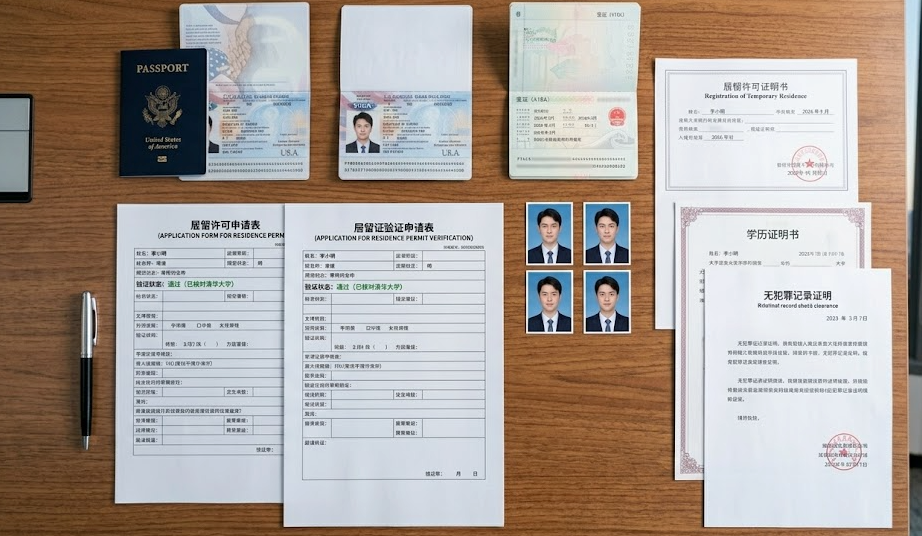
Residence permits are divided into the following types: work, study, journalist, family reunion, and personal matters.
Work residence permit (Z visa holders)
The most common permit for expats. You enter on a Z visa obtained with a Notification Letter for Foreigner's Work Permit, then convert it to a residence permit within 30 days of arrival.
Those who intend to work in China for more than 90 days shall apply for a Z visa, then apply for a work residence permit upon entry, and work within the validity period of the work permit.
The Foreigner Work Permit has three categories: Category A for high-end talent, Category B for professionals, and Category C for general workers. Your residence permit validity follows the tier of your work permit.
Study residence permit (X1 visa holders)
A foreign national entering China with an X1 visa shall submit a letter from the school indicating the term of study and a letter of admission or enrolment.
The residence permit may be issued with a residence period consistent with the indicated term of study.
Students on X2 visas (short-term study under 180 days) are generally not eligible for a residence permit.
Family reunion residence permit (Q1 visa holders)
The family reunion permit is issued to family members of Chinese citizens and family members of foreigners with permanent residence status in China who need to reside in China for family reunion, and to persons who need to reside in China for fosterage or other purposes.
A dependent spouse holding a family reunion residence permit is not automatically permitted to work in China.
If a dependent spouse wishes to work, they must secure their own independent work permit. China Legal Experts
Private affairs residence permit (S1 visa holders)
The personal matters permit is issued to spouses, parents, children under the age of 18, or parents-in-law of foreigners residing in China for work, study, or other purposes who apply for a long-term visit to China.
This permit covers dependents of foreign residents in China, as distinct from the family reunion permit, which applies to family members of Chinese citizens or permanent residents.
High-level talent permit (R visa holders)
R visa holders representing internationally recognized talent can access expedited processing and multi-year permits of up to 5 years.
Professionals or investors in line with the relevant requirements of the State may apply for a residence permit with the approval of the exit and entry departments of China's public security organs.
Table 1: China Residence Permit Types at a Glance (2026
Documents Required
Requirements vary by city and permit type, but the following apply across all categories.
Required for every permit type:
- Valid passport with at least 6 months' remaining validity
- Entry visa matching your purpose of stay (Z, X1, Q1, S1, or R as applicable)
- Recent passport-sized photo with a white background
- Completed application form (available at the PSB office)
- Proof of accommodation: rental agreement, property ownership documents, or university dormitory assignment letter
- Temporary Residence Registration Form (TRRF): the form issued when you register your address at the local police station within 24 hours of moving in
Additional documents by permit type:
- Work: Foreigner Work Permit card or approval notice, employment contract, employer's business license, evidence of tax and social insurance contributions
- Study: Admission letter, enrolment confirmation, tuition payment receipt, dormitory or lease agreement
- Family reunion: Notarised marriage or birth certificate (apostilled or legalised if issued abroad), Chinese spouse's or parent's national ID card or permanent residence card
- Private affairs: Copy of the principal foreign resident's valid residence permit and notarised proof of relationship
All foreign documents, such as marriage certificates or university degrees, must be properly authenticated or apostilled in your home country and translated into Chinese by a certified agency before they are accepted by the PSB.
For permits valid for more than 1 year:
Where a foreigner applies for a residence permit with a validity period of above 1 year, the applicant shall submit a health certificate issued by the local health and quarantine authority or health and medical institution at the county level, certifying that the applicant does not have a serious mental disorder, tuberculosis, or other infectious diseases which may potentially cause substantial hazard to public health. The health certificate is valid for 6 months from its issue date.
Step-by-Step Application Process

Step 1: Register your address within 24 hours of arrival
By law, all foreigners entering China must register their place of residence within 24 hours oclose to your application submission.
Step 4: Submit your application to the PSB
Visit the Exit-Entry Administration office of your local PSB in person. For foreigners who are high-level talents, urgently needed professionals, under 16 or over 60 years old, or disabled due to illness or other reasons, an application may be filed by the inviting entity, family, relatives, or a professional service agency on behalf of the applicant. Standard adult applicants must appear in person.
The PSB retains your passport during processing. Do not book international travel until you collect your permit.
Step 5: Wait for processing
The entire process from submission to pick-up takes seven working days. Complex cases or those requiring additional verification may take longer.
Step 6: Pay the fee and collect your permit
Once approved, return to the PSB, pay the applicable fee, and collect your passport with the residence permit stamped inside.
Renewal Rules
Foreigners who need to stay in China after the expiration of their residence permit shall apply for an extension at least 30 days before the expiration date.
Renewal documents typically include:
- Updated personal and category-specific documents (new employment contract, new enrolment letter, or updated family documentation)
- Proof of continued employment, study, or family status
- Tax and social insurance payment records (for work permit holders)
- Completed renewal application form
If your circumstances have changed (new employer, new school, or new address), you must update your permit information in addition to renewing it.
Overstaying your permit can result in fines, deportation, and difficulties with future applications.
Start the renewal process 60 days before expiry to allow adequate time for document preparation and PSB processing.
Employer, School, or Address Changes
Employer change (work permit holders)
If you change employers, you must transfer your Foreign Work Permit to the new employer before updating your residence permit:
- Obtain a work permit transfer approval reflecting the new employer from the relevant labor authority
- Apply for an amended work permit in the name of the new employer
- Update your residence permit at the PSB to reflect the employer change
- Keep the old permit valid until the new one is issued to avoid gaps in legal status
In case of any change in personal information such as name, passport number, and position, an application for changes shall be submitted to the administration department of foreigners working in China within 10 working days from the date the changes occur.
School change (student permit holders)
Obtain a transfer letter from your current institution, secure admission from the new institution, and update your residence permit at the PSB with the new admission letter and enrolment confirmation.
Address change
Re-register at the local police station within 24 hours of moving to a new address and update your address on record with the PSB. Re-registration is required each time you move, even within the same city.
Permanent Residence in China (Chinese Green Card)
For long-term residents who meet the qualifying criteria, permanent residence provides an indefinite right to live in China without periodic permit renewals.
Foreign nationals applying for permanent residence shall abide by Chinese laws, be in good health, have no criminal record, and meet one of the following conditions:
- made direct and stable investments in China with good tax records for three consecutive years;
- held a senior position or professional title in China for at least four consecutive years while residing in China for at least three of those four years, with good tax records
- or made significant and outstanding contributions, especially needed in China.
Permanent residence applications are selective and complex, and the approval period is up to 6 months. If you are approaching the eligibility threshold, seek legal advice well before you intend to apply.
Continue reading: Permanent Residence in China Application: Latest Requirements
Key Rules Every Foreigner Must Know
- You cannot convert a tourist (L) or short-term business (M) visa into a residence permit. You must leave China and re-enter on the correct long-term visa category.
- A family reunion residence permit does not automatically grant the right to work. Dependents must obtain their own work permit independently.
- If you renew your passport, update your residence permit information at the PSB within 10 days of the change.
- The 240-hour visa-free transit policy (extended from December 17, 2024) does not apply to people seeking a residence permit. It covers short-term transiting visitors only.
- China does not recognise dual citizenship. Any naturalisation application in another country can affect your immigration status in China.
Conclusion
Getting your China residence permit for foreigners right from the start establishes the legal foundation for everything that follows, from opening a bank account to qualifying for a tax residency certificate.
The 30-day window after entry is tight, and document preparation for foreign certificates, including notarisation, apostille or legalization, and certified Chinese translation, takes longer than most first-time applicants expect.
The practical priority list:
- Register your address at the local police station within 24 hours of moving in
- Book your health check immediately if applying for a permit valid over 1 year
- Start apostilling or legalizing foreign documents before you arrive in China where possible
- Submit your application well within the 30-day deadline
- Set a calendar reminder 30 to 60 days before expiry for renewal preparation
If your situation involves complex circumstances such as an employer change mid-permit, a family reunion application with documents from multiple countries, or a high-level talent application, professional legal assistance prevents costly rejections and delays.
Contact China Legal Experts for a confidential consultation on residence permits and immigration compliance
Subscribe to receive updates
Subscribe to receive the latest blog posts to your inbox every week.