
You want to sell pressure equipment in China, but the rules feel strict and unclear. One approval decides whether your products can enter the market or stop at customs.
SELO certification in China is a mandatory manufacturing license that you must hold to produce or sell regulated pressure equipment, such as pressure vessels, boilers, and related valves, in the Chinese market. The system operates under national safety laws and ends with a China Manufacture License issued by the market authority.
The process checks your design, production controls, and quality system. It also involves reviews by approved inspection bodies and close oversight by Chinese regulators, which makes early planning critical.
Key Takeaways
- SELO certification is required to access China’s special equipment market.
- The license focuses on safety, quality control, and legal compliance.
- Authorities closely review both your products and your manufacturing system.
What is SELO Certification in China?
SELO certification sets the legal rules you must meet to sell certain industrial products in China. It focuses on safety, compliance, and government control for high‑risk equipment such as pressure vessels and boilers.
Definition and Scope of SELO
SELO refers to the Special Equipment Licensing Office, which manages licensing for special equipment in China. When you seek SELO certification, you prove that your products meet China’s safety and quality laws.
The scope covers equipment that can pose safety risks if it fails. This includes pressure vessels, boilers, pressure piping, safety valves, and some hydrogen products.
You need a SELO license if you manufacture these products outside China and plan to sell or import them into the Chinese market. Without it, customs clearance and legal sales are not possible.
SELO certification focuses on product design, materials, manufacturing controls, and testing. It also reviews your quality management system to confirm consistent production.
China Manufacture License (CML) Explained
The China Manufacture License (CML) is the official license issued under the SELO system. Many people also call it the SELO license, TS license, or China stamp.
When you hold a CML, China recognizes you as an approved manufacturer of special equipment. This license applies to a specific product type, such as a pressure vessel license, not your full product range.
The CML allows you to apply the China stamp to approved products. This mark shows inspectors and buyers that your equipment meets Chinese safety rules.
The license does not last forever. You must renew it and pass follow‑up inspections to keep your approval active.
Regulatory Bodies and Oversight
The State Administration for Market Regulation (SAMR) oversees special equipment safety in China. SAMR holds final authority over SELO certification and license approval.
The Special Equipment Licensing Office (SELO) manages the licensing process on behalf of SAMR. It reviews applications and controls technical assessments.
Technical reviews and factory inspections are often carried out by the China Special Equipment Inspection and Research Institute (CSEI). CSEI checks product designs, test results, and manufacturing practices.
These bodies do not authorize private agents to issue licenses. You remain responsible for compliance, accuracy, and ongoing conformity with Chinese regulations.
SELO certification ensures equipment safety, but quality issues can still arise during production. Learn practical strategies to hold manufacturers accountable by reading our guide What To Do When a Supplier in China Won't Fix Defects.
Applicable Products and Equipment Categories
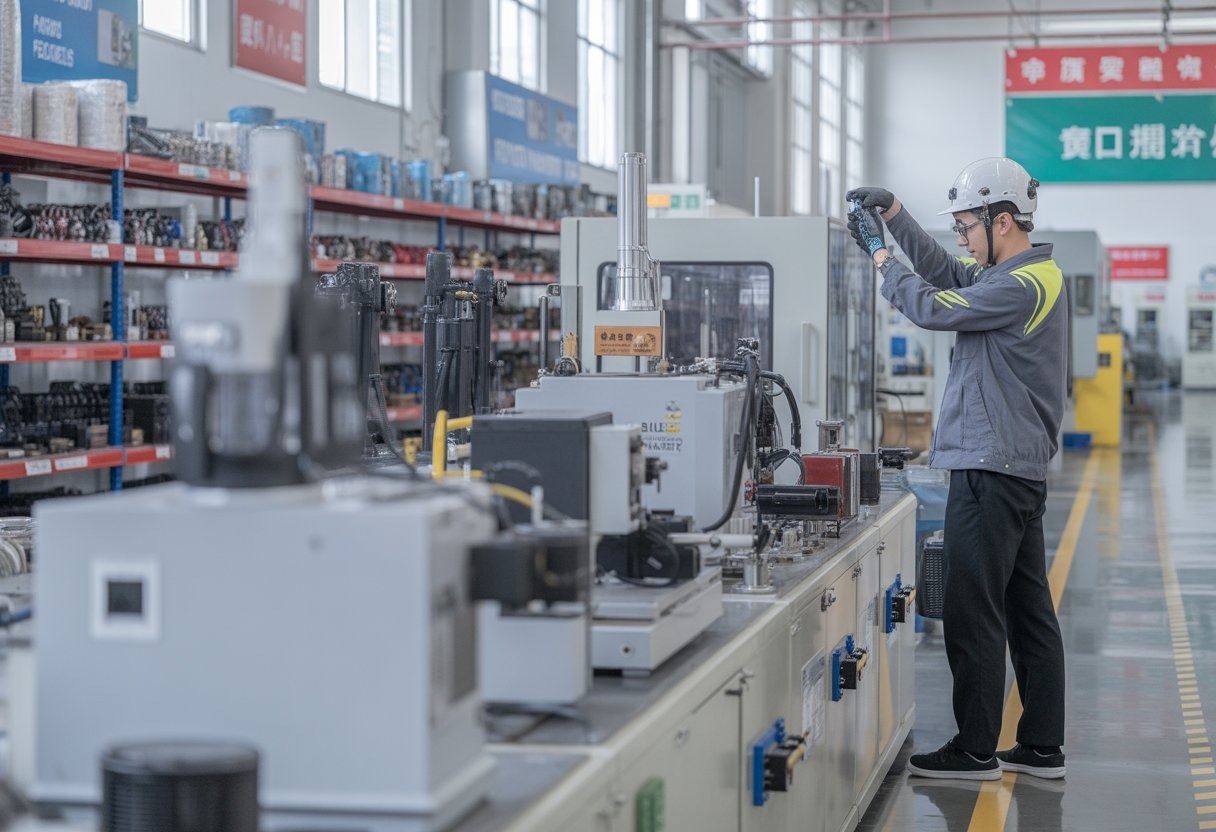
SELO certification applies to defined types of special equipment that China regulates for safety reasons. You must confirm whether your product falls into one of these categories before you sell or import it into China.
Pressure Vessels and Boilers
SELO certification covers pressure vessels and boilers used to store or generate pressurized fluids or gases. This group includes fixed pressure vessels, heat exchangers, and industrial boilers used in power, chemical, and manufacturing plants.
You must obtain certification if your equipment operates above regulated pressure or temperature limits. Authorities review your design documents, materials, and manufacturing process. They also assess your quality control system and testing methods.
Common examples include steam boilers, reaction vessels, and air receivers. Both domestic and foreign manufacturers must meet the same technical and safety standards before entering the Chinese market.
Gas Cylinders and Transportable Pressure Vessels
Gas cylinders and transportable pressure vessels require SELO certification because they move through public and industrial spaces. This category includes refillable and non-refillable cylinders used for industrial gases, medical gases, and hydrogen.
You must certify products such as seamless steel cylinders, composite cylinders, and tube trailers. Regulators focus on burst strength, fatigue life, and valve compatibility. They also review type testing and batch inspection plans.
If your product crosses borders or ships by road or sea within China, SELO approval becomes mandatory. Without it, customs and end users may reject the equipment.
Safety Parts and Valves
SELO certification also applies to safety parts, especially safety valves and related pressure-protection devices. These components play a direct role in preventing overpressure and system failure.
You need certification for spring-loaded safety valves, pilot-operated valves, and rupture devices used on special equipment. Authorities verify set pressure accuracy, discharge capacity, and sealing performance.
They also inspect your production controls and calibration processes. Even if the main equipment holds approval, uncertified safety parts can block market access or delay project approval.
Understand how licensing and government oversight work together in our article: China's Legal Framework for Foreign Business Operations.
SELO Certification Process Overview
The SELO certification process follows China’s special equipment licensing rules. You must confirm whether your product falls under regulation, submit approved documents, pass technical reviews, and complete a factory audit led by Chinese authorities.
Obligation Assessment and Product Classification
You start by confirming whether your product requires a SELO certificate. China regulates special equipment such as pressure vessels, pressure piping, valves, boilers, and some hydrogen-related products.
You classify the product based on pressure level, medium, volume, and use. This step matters because it defines the licensing path, testing scope, and audit depth.
CSEI, acting under SELO, reviews the classification. Incorrect classification often leads to delays or rework.
Typical outcomes include:
- Design and manufacturing license required
- Production and filling licensing
- No SELO obligation
You should complete this step before any formal submission.
Documentation and Submission Requirements
You prepare a full application package for SELO review. The Special Equipment Licensing Office checks all documents for completeness and accuracy.
Required documents usually include:
- Company legal registration and quality manual
- Product drawings and technical specifications
- Design codes and applied standards
- Manufacturing and inspection procedures
You submit documents in Chinese or with certified translations. SELO performs document appraisal through CSEI engineers.
Missing or inconsistent data often triggers corrective actions. You should align all documents with Chinese GB or approved international standards before submission.
Design Approval and Type Tests
After document acceptance, SELO moves the application into design approval. CSEI engineers review drawings, calculations, and safety factors.
Some products also require type tests at approved laboratories in China. These tests verify pressure strength, material performance, and safety functions.
Design approval must finish before mass production. You cannot ship regulated equipment without this step.
Test reports and approved drawings become part of the SELO certification file. Any design change later requires re-approval.
On-Site Factory Audit and Final Approval
SELO schedules an on-site factory audit once design approval is complete. CSEI auditors visit your production site.
During the audit, they verify:
- Quality management system use
- Welding and inspection controls
- Material traceability
- Staff qualifications and records
Auditors also confirm that production matches approved designs. You must address any nonconformities within the given timeframe.
After successful closure, SELO issues the SELO certificate, also known as the China Manufacture License. This approval allows legal sales and importation into China.
Discover other industry standards and sector-specific rules in our resource, Manufacturing in China: Understanding Industry-Specific Regulations.
Key Chinese Regulations and Standards
China sets clear legal and technical rules for SELO certification. These rules define how you design, make, test, and manage pressure equipment under a single safety system.
TSG Z0004-2007 and TSG Regulations
TSG Z0004-2007 sets the core quality system rules for special equipment makers. You must build and follow a written quality manual that fits your products and processes. Auditors review this system during SELO approval.
This regulation focuses on special equipment quality assurance. You must assign trained staff, control documents, and manage suppliers. You also need clear rules for design control, material traceability, and non‑conforming products.
Other TSG regulations work with TSG Z0004-2007. They define safety duties across design, manufacturing, inspection, and after-sales service. You must follow the TSG rules that match your equipment type, such as pressure vessels or valves. SAMR enforces these rules through audits and licensing actions.
TSG 07-2019: Production and Filling Licensing
TSG 07-2019 applies to companies that produce or fill special equipment, including pressure vessels and gas cylinders. You must hold the correct license before you start these activities in or for China.
This regulation sets clear entry conditions. You must prove staff competence, equipment capability, and process control. Factory audits check welding control, testing methods, and safety procedures.
TSG 07-2019 also defines license scope and validity. You can only produce or fill within the approved range. Any major change, such as a new site or product type, requires approval. You must keep records and accept regular supervision to keep your SELO license active.
Relevant GB Standards
GB standards support TSG rules by setting technical details for design and testing. Some GB standards are mandatory when safety is involved. Others serve as accepted technical references.
You must select the right GB standards for your equipment. Auditors expect proof of use and compliance.
You must align GB standards with TSG Z0004 and TSG 07-2019. This alignment shows full control over safety, quality, and regulatory compliance.
Check out our guide: Who Holds Contract Signing Authority in Chinese Companies? for clarity on signature authority and legal representation.
Role of Authorities and Institutions
Several Chinese authorities control SELO certification. Each body has a clear role in lawmaking, licensing, technical review, and inspection. You must know who does what to plan approval steps and manage audits.
State Administration for Market Regulation (SAMR)
SAMR leads the national system for special equipment control. You deal with SAMR because it issues the China Manufacture License (CML), also known as the SELO license.
SAMR sets rules for design, production, testing, and quality systems. These rules come from special equipment safety laws and TSG regulations. SAMR also approves foreign manufacturers that want to sell regulated equipment in China.
Key responsibilities include:
- License approval and renewal
- National policy and rule setting
- Oversight of SELO and technical bodies
SAMR replaced AQSIQ in 2018. Many older rules still reference AQSIQ, but SAMR now enforces them.
Special Equipment Licensing Office (SELO)
SELO runs the licensing process for special equipment. You interact with SELO during application, review, and approval steps.
SELO checks your documents, audit results, and test reports. It also manages license records and official stamps. SELO does not authorize agents or consultants. You remain responsible for all submitted materials.
SELO licenses cover equipment such as:
- Pressure vessels
- Boilers
- Pressure piping
- Gas cylinders
The license stays valid for four years. You must apply for renewal before it expires to avoid sales blocks in China.
China Special Equipment Inspection and Research Institute (CSEI)
CSEI provides technical support for SELO and SAMR. You often work with CSEI during design review and type testing.
CSEI reviews drawings, calculations, and material data. It also performs or witnesses tests based on Chinese standards. These results support your SELO license decision.
CSEI acts as a neutral technical body. It does not issue licenses. Its role focuses on safety, compliance, and risk control for special equipment.
You may need CSEI when:
- Your product uses non-standard materials
- Your design follows foreign codes
- SAMR requires expert technical review
Additional Regulatory Agencies
Several other agencies support the system at local and sector levels. You may face them during audits, inspections, or market checks.
These bodies include:
- Local Market Regulation Bureaus for factory audits
- Designated inspection institutes for product testing
- Customs authorities for import clearance
Some rules still cite AQSIQ due to legacy laws. SAMR now oversees these functions. Local agencies enforce compliance after licensing, especially during production and on-site inspections.
Prepare effectively by exploring our article, Company Health Check China: Financial, Legal & Compliance Audit, to understand Chinese audit procedures.
Challenges, Updates, and Best Practices
SELO certification in China brings strict technical, legal, and operational demands. You must manage quality systems, track rule changes, and keep licenses valid across production and filling activities.
Common Pitfalls and Compliance Issues
You often face delays when documents do not match actual production conditions. Chinese authorities review drawings, material lists, welding records, and test reports in detail. Inconsistent data can trigger rework or on-site findings.
Weak special equipment quality assurance systems cause many failures. Inspectors expect clear roles, trained staff, and written controls for design, production, and inspection. Missing internal audits or incomplete training records raise compliance risks.
You may also confuse SELO with CCC certification. SELO covers special equipment manufacturing and filling, while CCC applies to specific product categories. Applying the wrong scope or license type can halt approval.
- Incomplete technical files
- Unapproved subcontractors
- Poor traceability of materials and welds
Recent Regulatory Changes
China has tightened control over production and filling licensing for special equipment. Recent updates stress accountability, staff qualifications, and factory readiness. Authorities now check whether your site matches the approved license scope.
Regulators place more weight on on-site audits. Inspectors verify that your equipment, processes, and personnel align with submitted documents. Remote or paper-only reviews no longer meet expectations.
Rules also reinforce the link between SELO and product safety laws. If your equipment falls under mandatory certification, you may need both SELO and CCC certification before market entry.
- Stricter on-site inspections
- Higher expectations for quality system maturity
- Clear separation between license scope and product use
Renewal, Modification, and Ongoing Compliance
SELO licenses have fixed validity periods. You must apply for renewal before expiration to avoid production stops. Late applications often lead to full re-audits instead of simple extensions.
Any change to design, materials, key staff, or factory location requires a license modification. Authorities treat unreported changes as non-compliance, even if product quality stays the same.
Ongoing compliance depends on daily controls. You should run internal audits, maintain training plans, and keep records inspection-ready at all times. This approach reduces risk during surprise audits.
- Track license scope against actual operations
- Review compliance quarterly, not yearly
- Align quality assurance with Chinese regulations, not only ISO standards
When certification delays or regulatory conflicts occur, you need clear resolution strategies. Our article on How to Handle Business Disputes in China: Contracts, Arbitration, and Law provides practical steps for resolving disputes with authorities and partners.
Conclusion
SELO certification is not optional if you want to sell pressure equipment in China. The process demands careful planning, accurate documentation, and full compliance with national safety rules.
You must align your design, quality systems, and factory controls with Chinese regulations before approval. Any gap can delay market entry or block sales entirely.
Don't navigate this complex system alone. Consult China Legal Experts today to review your product scope, prepare compliant documents, and guide you through every stage of the SELO certification process. Get the right advice now and secure your license faster.
Frequently Asked Questions
What are the requirements for obtaining SELO certification for pressure vessels in China?
You must prove that your pressure vessel design, materials, and manufacturing controls meet Chinese safety rules. This includes compliance with national standards and applicable safety regulations for special equipment.
You also need a qualified quality management system. Chinese authorities review your factory conditions and production controls as part of the approval.
How does the SELO certification process differ for foreign manufacturers versus domestic manufacturers in China?
If you manufacture outside China, you must appoint a local representative to work with SELO. Authorities review your overseas factory through document checks and, in many cases, an on-site audit.
Domestic manufacturers follow a similar process but complete inspections inside China. Communication and scheduling tend to move faster for local factories.
What documentation is needed to apply for SELE certification in China?
You must submit design drawings, calculation reports, and material specifications. Authorities also require quality manuals, welding procedures, and inspection records.
Foreign manufacturers must provide translated documents in Chinese. SELO reviews all files before allowing testing or audits.
Are there specific standards and codes that products must meet to be SELO certified in China?
Your product must meet Chinese national standards, such as GB standards and relevant TSG safety regulations. These rules define design limits, testing methods, and inspection steps.
In some cases, SELO may accept international codes like ASME. Authorities still require a technical review to confirm alignment with Chinese rules.
What is the typical timeline for the SELO certification approval process in China?
The process usually takes six to twelve months. The timeline depends on product complexity, document quality, and audit results.
Delays often happen when documents need revision or when audits reveal gaps. Clear preparation helps reduce rework.
Can SELO certification be expedited for urgent projects in China?
SELO does not offer a formal fast-track program. Authorities follow fixed review and safety steps.
You can reduce delays by submitting complete documents and responding quickly to comments. Final approval still follows standard timelines.
Subscribe to receive updates
Subscribe to receive the latest blog posts to your inbox every week.




.png)