
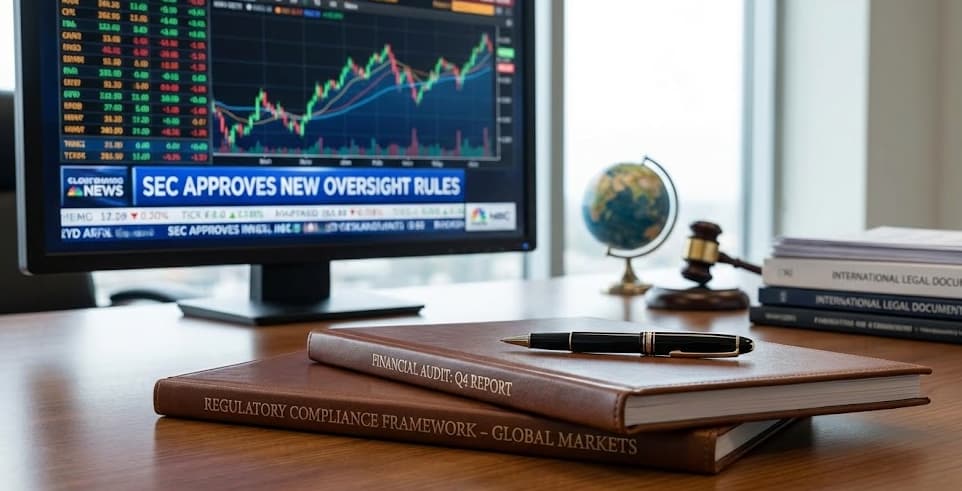
The Holding Foreign Companies Accountable Act (HFCAA) fundamentally changed how Chinese companies access U.S. capital markets by requiring compliance with Public Company Accounting Oversight Board (PCAOB) audit inspections.
Originally enacted in December 2020, this federal law addresses longstanding concerns about audit transparency for foreign issuers whose auditors operate in jurisdictions that restrict PCAOB access.
While the PCAOB vacated its 2021 determinations against China and Hong Kong auditors in December 2022 after securing inspection access, understanding HFCAA remains critical for investors and businesses navigating cross-border investments.
What Is the Holding Foreign Companies Accountable Act?

Consider the HFCAA a "transparency law." It is a U.S. federal regulation designed to prevent foreign companies from concealing financial information from U.S. regulators.
The law targets public companies that hire accounting firms in countries where the U.S. watchdog (the PCAOB) is blocked from doing its job. It uses a two-step enforcement process:
- The PCAOB determines if a specific country is blocking their inspections.
- The SEC then identifies which companies use auditors in that blocked country and demands compliance.
This system ensures that if a company seeks to trade on the New York Stock Exchange or NASDAQ, it must comply with the same transparency rules as American firms.
How HFCAA Affects Chinese Companies
For years, Chinese companies were stuck in a "double bind." The U.S. demanded audit records, but Chinese national security laws prohibited their disclosure.
This conflict peaked in 2022. The SEC identified more than 200 China-based companies—including tech giants such as NIO, XPeng, and Tencent Music—as at risk of delisting.
The urgency increased following Congress's amendment to the HFCAA. Originally, companies had three years to fix the issue.
The new rule shortened this to just two years. This meant that if China didn't open its books quickly, hundreds of billions of dollars in market value could have been wiped off U.S. exchanges.
Fortunately, a breakthrough occurred in late 2022. Chinese authorities agreed to permit PCAOB inspectors to review audit workpapers in Hong Kong.
As a result, the "delisting clock" was reset, and as of early 2026, no trading bans are currently active.
Compliance: What Companies Must Do
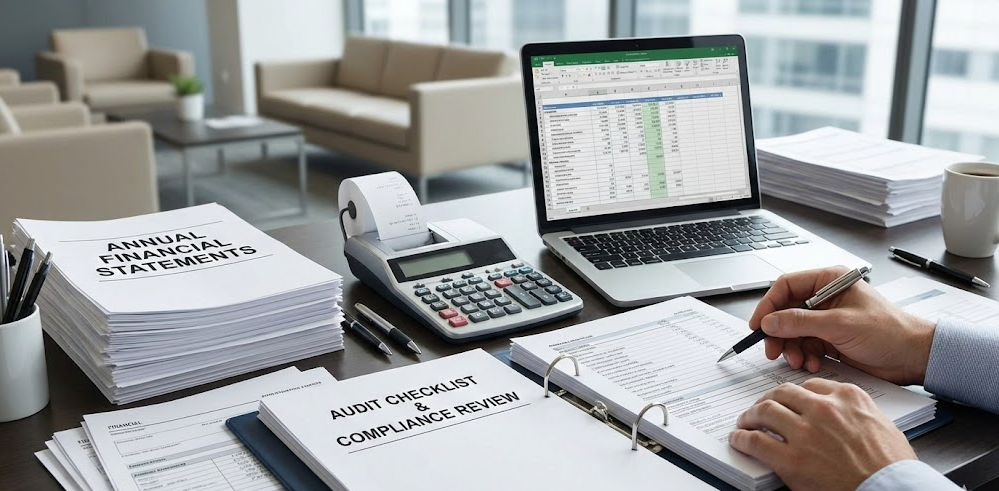
If a company gets flagged under the HFCAA, it has to act fast to stay listed.
✅ The "Proof" Requirement
Once identified, a company must submit evidence to the SEC proving that its auditor is indeed subject to U.S. inspection.
If the SEC provisionally identifies a company, that firm has only 15 business days to dispute the claim by emailing evidence to hfcaa@sec.gov.
✅ Mandatory Disclosures
Beyond audits, the law requires transparency regarding political connections. Companies must disclose:
- The percentage of shares owned by government entities.
- Whether any board members are officials of the Chinese Communist Party.
These rules are designed to help investors understand exactly who controls the company they are investing in.
Impact on Investors and Markets
The HFCAA has been a rollercoaster for investors.
During 2021 and 2022, fear of delisting caused massive volatility in Chinese ADRs (American Depositary Receipts). Many investors sold off their holdings, fearing their stocks would become worthless if they were kicked off U.S. exchanges.
The "Hedging" Strategy
To protect themselves, many Chinese giants pursued "dual listings." For example, a company listed on the NYSE might also launch a listing on the Hong Kong Stock Exchange. This acts as a safety net: if they get kicked out of the U.S., their shares can still trade in Hong Kong.
Advice for Investors
Even though the immediate danger has passed, financial advisors recommend staying alert. You should regularly check the SEC’s HFCAA list. Geopolitical moods can change quickly; if the U.S. and China disagree again in the future, the risk could return overnight.
Legal Strategies for Chinese Companies
How can Chinese companies protect their U.S. status?
- Switch Auditors: The most direct path is to hire an accounting firm that the PCAOB can already inspect, often one based in the U.S. or Singapore.
- Corporate Restructuring: Some firms restructure to ensure their governance is transparent and independent of state restrictions.
- Legal Preparation: Companies need legal teams that specialize in cross-border regulations to prepare "contingency plans." This ensures that if the rules change, they can react immediately rather than scrambling.
The PCAOB Inspection Framework
The agreement signed in December 2022 was a game-changer. It established a framework that finally allowed U.S. inspectors to work in Hong Kong and mainland China.
What Access Did the U.S. Get?
The PCAOB secured four critical wins:
- Access to all audit work papers.
- The right to interview audit staff without government minders.
- The ability to choose any document to review, not just the ones China selected.
- Freedom from excessive redactions (blacking out text).
In late 2022, more than 30 PCAOB staff spent nine weeks in Hong Kong testing this system.
They reviewed thousands of pages and confirmed that China was complying. Because of this successful test, the threat of mass delisting was paused.
👉 For specialized guidance on corporate structure and cross-border compliance, reviewing the Foreign Investment Law in China is a necessary step for any board of directors.
HFCAA vs. Other Regulations
It is important not to confuse HFCAA with other sanctions.
- Export Controls / Entity List: These restrict access to technology (like chips) for national security reasons.
- CFIUS Reviews: These block foreign companies from buying U.S. businesses.
- HFCAA: This is purely about financial transparency. It doesn't ban Chinese companies because they are Chinese; it bans them only if they refuse to show their audit math.
However, complying with HFCAA can be tricky because it sometimes clashes with China's own data security laws.
Balancing "U.S. transparency" with "Chinese state secrets" remains a delicate legal tightrope.
Conclusion
The Holding Foreign Companies Accountable Act was a wake-up call that nearly severed financial ties between the U.S. and China. While diplomacy prevailed in 2022 and avoided a mass market exit, the law remains fully active.
For investors and businesses, the lesson is clear: transparency is no longer optional. Staying compliant requires constant vigilance, regular monitoring of SEC updates, and a proactive legal strategy to navigate the shifting tides of U.S.-China relations.
FAQs About the Holding Foreign Companies Accountable Act
What happens if a company is identified under HFCAA?
First, it goes on a "provisional" list. The company has 15 business days to prove the SEC is wrong. If they can't, they move to the "conclusive" list. If a company stays on this bad list for two years in a row, its stock is banned from trading in the U.S..
Can Chinese companies still list on the New York Stock Exchange?
Yes. As long as their auditors accept U.S. inspections, they are welcome. Since late 2022, China has allowed these inspections, so the door remains open for compliant companies.
Is my money safe in Chinese stocks right now?
The immediate risk of your stock being delisted simply for being Chinese has dropped significantly since the 2022 agreement. However, these stocks can still be volatile due to other economic or political factors. Always monitor the news for changes in PCAOB access.
Who decides if a company is non-compliant?
It is a team effort. The PCAOB (the auditor watchdog) decides if a country is blocking them. The SEC (the market regulator) then checks which companies use auditors in that blocked country and adds them to the list.
Could the delisting threat come back?
Yes. If the Chinese government decides to stop cooperating with U.S. inspectors in the future, the PCAOB will issue a new "determination." This would restart the clock, and delisting bans could return.
Subscribe to receive updates
Subscribe to receive the latest blog posts to your inbox every week.




.png)