
Living as an expat in China means following the country's strict traffic laws, and DUI regulations are among the toughest you'll encounter. China has a zero-tolerance approach to drunk driving, with a blood alcohol concentration limit of just 0.02% for standard DUI charges and 0.08% for more serious drunk driving offenses. Violations can result in heavy fines, license suspension, criminal charges, and even deportation.
If you're planning to drive in China or already do, you need to know what's at stake. The penalties for drinking and driving go beyond just paying a fine. A DUI conviction can affect your visa status, employment prospects, and ability to stay in the country.
This guide covers DUI laws in China for expats, including penalties, enforcement procedures, how a DUI affects travel and immigration, and practical steps to avoid legal trouble.
Key Takeaways
- China enforces a 0.02% BAC limit for regular DUI and 0.08% for drunk driving charges with severe penalties including fines, license suspension, and possible jail time
- A DUI conviction in China can lead to visa cancellation, deportation, and long-term immigration consequences for expats
- Having a DUI on your record from another country may result in being denied entry or a visa to China depending on the severity and timing of the offense
DUI Laws and Blood Alcohol Concentration Standards in China
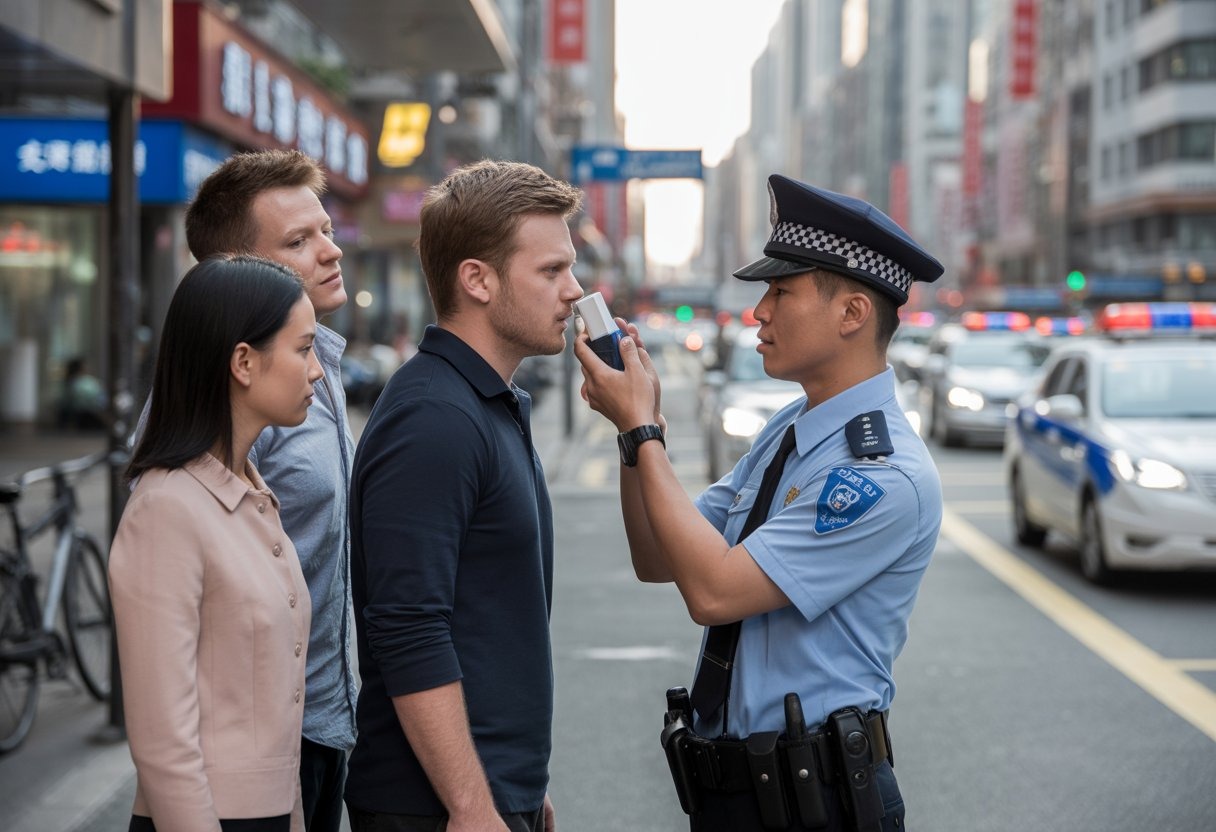
China enforces strict blood alcohol concentration limits that divide drunk driving into two categories with different legal penalties. The law distinguishes between lower-level administrative violations and serious criminal offenses based on your BAC reading and driving behavior.
Blood Alcohol Concentration Limits for Private and Commercial Drivers
China sets its BAC limit at 20mg/100ml (0.02%) for all drivers. This threshold is significantly lower than limits in many Western countries.
If your BAC reaches 80mg/100ml (0.08%) or higher, you cross into criminal territory. China does not maintain different BAC standards for private versus commercial drivers. The same limits apply regardless of your vehicle type or driving experience.
The 0.02% limit means that even one standard drink can push you over the legal threshold. Your body weight, metabolism, and the time between drinking and driving all affect your BAC. Police use breathalyzers at checkpoints and after accidents to measure your alcohol concentration.
Legal Distinctions: Driving After Drinking vs. Driving While Intoxicated
China separates alcohol-related driving offenses into two categories. Driving after drinking applies when your BAC measures between 20mg/100ml and 79mg/100ml. This violation results in administrative penalties.
Driving while intoxicated occurs when your BAC reaches 80mg/100ml or above. This becomes a criminal offense under Chinese law. The distinction matters because criminal convictions carry harsher penalties than administrative violations.
Administrative penalties for driving after drinking include fines, license suspension, and detention up to 15 days. Criminal charges for driving while intoxicated can result in jail time ranging from one to six months, permanent license revocation, and a criminal record that affects your visa status.
China DUI Law Enforcement Procedures
Police conduct random sobriety checkpoints throughout Chinese cities, especially during holidays and weekends. Officers can stop you without specific cause at these checkpoints.
When stopped, you must submit to a breathalyzer test if requested. Refusing the test results in the same penalties as a failed test. If your breath test shows elevated BAC, police will take you to a medical facility for a blood test.
The blood test provides the official measurement used in legal proceedings. You will be detained at the police station while awaiting results. Police will document the incident through photographs, videos, and written statements. Your passport will be confiscated if you face criminal charges, and you cannot leave China until your case concludes.
By reading our guide, 10 Laws in China That Impact International Business, you’ll understand the key regulations that affect foreign professionals, investors, and expats operating in China.
Penalties and Consequences for DUI Offenses in China

China enforces strict penalties for driving under the influence, separating offenses into two categories based on blood alcohol concentration. Lower BAC levels result in administrative penalties, while higher levels lead to criminal prosecution with potential jail time.
Administrative Penalties for DUI
If your blood alcohol concentration measures between 20-80 mg/100ml (0.02-0.08%), you face administrative penalties for driving after drinking. These offenses are called "driving under the influence" rather than drunk driving.
For a first offense, authorities will suspend your license for six months. You will also receive a fine between 1,000-2,000 yuan and 12 demerit points on your license.
If you commit a second offense, the consequences increase significantly. You face up to 10 days in administrative detention, another fine of 1,000-2,000 yuan, and permanent license revocation.
Commercial vehicle drivers receive harsher treatment. Your first offense brings a mandatory three-month suspension and a 500 yuan fine. Any subsequent offense while driving a commercial vehicle results in 15 days of administrative detention and license revocation.
Criminal Charges and Their Impact
Driving while intoxicated becomes a criminal offense when your blood alcohol concentration reaches 80 mg/100ml or higher. China updated these standards in December 2023 to clarify criminal liability thresholds.
A drunk driving conviction puts you in the criminal justice system. You will face criminal detention, which can range from several months to years depending on circumstances. The court considers factors like your degree of intoxication, vehicle type, road conditions, speed, and whether you caused an accident.
Your criminal record remains permanent. This affects your ability to work in China, apply for visas, and travel internationally. Many employers conduct background checks that will reveal your conviction.
Aggravated Drunk Driving Offenses
Certain circumstances make drunk driving penalties more severe. If you cause a traffic accident while intoxicated, authorities impose harsh punishments regardless of injury severity.
The guidelines specify enhanced penalties for dangerous driving situations. These include driving on highways, operating buses or trucks, excessive speeding, or driving during peak traffic hours.
If you surrender to police and confess immediately after drunk driving, you may receive some leniency. Voluntarily pleading guilty can also reduce your sentence under the 2023 updated guidelines.
Read our article, Driving in China: Licensing and Key Traffic Rules, to learn the essential traffic laws, licensing requirements, and compliance rules every expat driver must follow.
DUI Enforcement and Testing Procedures for Expats
Chinese police have broad authority to conduct DUI enforcement operations at any time and location. You face strict testing procedures with little room for negotiation, and enforcement intensity varies depending on where you're living in China.
Random Breath Tests and Checkpoints
Police in China can stop you for a breath test without needing probable cause or observing suspicious driving behavior. Random checkpoints appear frequently on major roads, especially during holidays and weekends.
Officers use handheld breathalyzer devices to measure your blood alcohol concentration on the spot. The legal threshold is 0.02% BAC for driving under the influence charges and 0.08% BAC for criminal drunk driving charges. These limits are much lower than what you might be used to in Western countries.
You might encounter checkpoints near popular expat areas, bars, and restaurants. Police often set up testing stations during evening hours when alcohol consumption is more common. The tests take only a few minutes, and results are immediate.
If your initial breath test shows alcohol, officers will conduct a second test for confirmation. You have no right to refuse these tests under Chinese law.
Refusal to Submit to Testing
Refusing a breath test carries the same penalties as a drunk driving conviction in China. You will face immediate arrest and license suspension if you decline testing.
Police treat test refusal as an admission of guilt. The law assumes you were driving drunk if you won't cooperate with testing procedures. You can expect fines, detention, and criminal charges identical to those for failing a breath test.
Some expats mistakenly believe they can avoid consequences by refusing the test. This strategy fails in China's legal system. Officers have the authority to use force if necessary to conduct testing or take you into custody.
Regional Differences in Enforcement
Major cities like Beijing, Shanghai, and Shenzhen have the strictest enforcement. You'll see more checkpoints and face higher scrutiny in these areas.
Smaller cities and rural areas generally have less frequent testing, but penalties remain the same across all regions. Tourist destinations often increase enforcement during peak travel seasons.
Police in expat-heavy neighborhoods know to watch for foreign drivers. You don't receive special treatment or leniency because you're not Chinese.
Explore our guide, China Residence Permit: Everything You Need to Know, to understand how legal violations can impact your immigration status and long-term stay.
Traveling to China with a DUI on Record
China maintains strict immigration policies that give officials discretion to deny entry based on criminal records, including DUI convictions. The visa application process requires careful attention to disclosure requirements and proper documentation.
Visa Application Process for Individuals with a DUI
When you apply for a Chinese visa with a DUI on your record, you'll need to complete the standard visa application form through the Chinese embassy or consulate. The application asks about criminal history, and how you answer can significantly impact your approval chances.
Your DUI status alone doesn't automatically disqualify you from receiving a visa. However, Chinese immigration authorities review applications individually and consider factors like the severity of your offense and when it occurred. Recent DUI convictions typically face more scrutiny than older ones.
You should gather all relevant court documents before starting your application. These include your conviction records, sentencing documents, and proof of completed requirements like probation or alcohol education programs. Having organized documentation ready helps streamline the process if officials request additional information.
Entry Restrictions and Discretionary Decisions
Chinese border officials have the authority to deny entry even if you hold a valid visa. They can make discretionary decisions based on your criminal record at the port of entry. This means approval for a visa doesn't guarantee you'll be allowed into the country.
Key factors officials consider include:
- How long ago the DUI occurred
- Whether you have multiple DUI convictions
- The specific circumstances of your case
- Your purpose for visiting China
A single misdemeanor DUI from several years ago generally poses less risk than multiple recent offenses. Business travelers and those with strong ties to legitimate activities in China may receive more favorable consideration.
Disclosure Requirements and Legal Documentation
You must disclose your DUI conviction truthfully on visa applications. Providing false information constitutes visa fraud and results in automatic denial plus potential bans from future entry. Chinese authorities can access international criminal databases and verify your background.
Your documentation should include certified copies of court records showing the final disposition of your case. If your DUI was expunged or sealed under U.S. law, you still need to disclose it on Chinese visa applications. China doesn't recognize U.S. expungement for immigration purposes.
Consider obtaining a legal opinion letter from an immigration attorney explaining your conviction and rehabilitation efforts. While not required, this documentation can support your application when dealing with more serious or recent DUI cases.
Check out China Employment Disputes: Laws and Best Practices, to learn how terminations, contract disputes, and employee rights are handled under Chinese law.
Employment, Immigration, and Legal Records
A DUI conviction creates serious complications for expats working in China because employers and immigration authorities conduct thorough background checks. Your criminal record affects work permit applications, residence permits, and your ability to maintain legal employment status in the country.
Police Clearance Certificate and Background Checks
You need a police clearance certificate from your home country when applying for a work permit in China. This document shows your criminal history, including any DUI convictions.
Chinese authorities check these certificates carefully during the work permit application process. A DUI on your record can lead to rejection of your application. The outcome depends on when the offense occurred and whether it was a misdemeanor or felony.
Key documents required:
- Police clearance certificate (must be recent, typically within 6 months)
- Authentication from your home country
- Chinese embassy or consulate verification
Some provinces in China have stricter requirements than others. First-time DUI offenders may have better chances than repeat offenders, but there is no guarantee of approval.
Impact of DUI on Work Permits and Residence
Your work permit status in China is directly linked to your residence permit. If authorities deny your work permit due to a DUI, you cannot legally work or stay long-term in the country.
Current work permit holders must renew their permits periodically. A DUI conviction while working in China puts your renewal at risk. Your employer must report criminal activity to immigration authorities.
Foreign nationals working in China are classified into categories (A, B, or C) based on qualifications. A DUI conviction can lower your category or disqualify you. Category A workers (high-level talent) may receive more consideration, but approval is not automatic.
Consequences for Social Credit and Insurance
China's social credit system tracks legal violations for both citizens and foreign residents. A DUI conviction in China enters this system and affects your daily life.
Potential impacts include:
- Difficulty obtaining health insurance
- Problems securing housing rentals
- Restrictions on purchasing transportation tickets
- Issues with banking services
Your employer's insurance coverage may exclude incidents related to drunk driving. This means medical costs from a DUI-related accident come out of your pocket. Some companies terminate employment contracts immediately after a DUI arrest, regardless of conviction status.
Discover the requirements in Do I Need a Work Permit for a Business Trip to China? to ensure your business travel remains fully compliant.
Practical Guidance for Expats on Avoiding DUI Issues
Expats in China need to understand practical steps to avoid DUI problems, including safe transportation options after drinking, knowing where to get legal help, and understanding how a prior DUI conviction affects entry into the country.
Alternatives to Driving After Drinking
China enforces a strict 0.02% BAC limit, which means even one drink can put you over the legal threshold. You should never drive after consuming any alcohol.
Safe Transportation Options:
- Ride-hailing apps - Didi is China's main ride-sharing service and operates 24/7 in most cities
- Taxi services - Available throughout urban areas with English-speaking dispatch options in major cities
- Designated driver services - Companies provide drivers who will drive your car home for you
- Public transportation - Metro systems in major cities run until late evening
- Walking - For short distances in safe, well-lit areas
Designated driver services are popular in China. These services send a driver to your location who will drive you home in your own vehicle. This option costs between 50-200 yuan depending on distance.
Many restaurants and bars can arrange transportation for you. Ask staff to call a taxi or help you book a ride through an app if you need assistance.
Legal Advice and Embassy Assistance
Your country's embassy or consulate can provide support if you face DUI charges in China. They can connect you with English-speaking lawyers familiar with Chinese law and your rights as a foreign national.
Contact your embassy immediately if arrested. They cannot get you out of jail, but they can ensure you receive fair treatment under Chinese law. Embassy staff will visit you, help you find legal representation, and notify your family if needed.
Save your embassy's emergency contact number in your phone before any situation arises. Most embassies maintain 24-hour hotlines for citizens in legal trouble.
Chinese lawyers who specialize in foreign national cases understand the specific challenges expats face. These attorneys typically charge 10,000-50,000 yuan for DUI defense, depending on case complexity.
Preparing for Travel with a DUI History
Traveling to China with a DUI on your record requires careful preparation. China's immigration authorities can deny entry to individuals with criminal records, including DUI convictions.
Your visa application requires honest disclosure of any criminal history. Lying on visa applications can result in permanent entry bans. The severity and age of your conviction affect your chances of approval.
Steps to take when applying:
- Obtain certified copies of all court documents related to your case
- Get a letter from your lawyer explaining the circumstances and resolution
- Apply for your visa well in advance of planned travel dates
- Consider working with a visa service that specializes in complicated cases
Recent DUI convictions (within 1-2 years) face higher scrutiny than older ones. Each case is reviewed individually, so outcomes vary.
You may need to provide character references, proof of rehabilitation, or evidence that your conviction has been expunged. Working visa applications typically undergo more thorough background checks than tourist visas.
Review Commercial Disputes China: How Businesses Can Resolve Conflicts Effectively, to understand dispute resolution options and how to protect your legal interests in China.
Bottomline
A DUI in China can do more than suspend your license. It can trigger criminal charges, visa cancellation, job loss, and even deportation. For expats, the risks are serious and long-lasting. If you are facing investigation, detention, or immigration complications, early legal guidance is critical.
Consult China Legal Experts today for a Confidential Consultation or request a Preliminary Legal Analysis to understand your options and protect your future in China.
You may also explore our related guides on employment compliance, immigration rules, and criminal liability to stay fully informed.
Frequently Asked Questions
Expatriates in China face strict DUI laws with a legal blood alcohol limit of 0.02%, criminal charges that can lead to detention and fines, and potential visa complications that may result in deportation or entry bans.
What are the legal consequences for expatriates caught driving under the influence in China?
You will face criminal charges if you are caught driving with a blood alcohol content of 0.02% or higher in China. This threshold is significantly lower than most Western countries.
If your BAC reaches 0.08% or above, you will be charged with drunk driving, which carries more severe penalties. You can expect detention, fines ranging from several thousand yuan, license suspension, and potentially a prison sentence.
The Chinese authorities will arrest you immediately upon suspicion of DUI. You may spend days or weeks in detention while your case is processed through the legal system.
How does the Chinese legal system handle DUI cases involving foreign nationals?
Chinese courts process DUI cases involving foreigners through the same criminal justice system used for Chinese citizens. You will be required to attend court hearings and may need an interpreter if you do not speak Mandarin.
The police will conduct breath or blood tests at the scene or at a police station. Your case will be handled by the local Public Security Bureau, which will determine whether to file criminal charges.
You should expect the legal process to take several weeks or months. During this time, you may be held in detention or released on bail depending on the severity of your case.
Are there any differences in DUI laws for expatriates compared to Chinese citizens?
The DUI laws themselves apply equally to both expatriates and Chinese citizens. You face the same BAC limits, criminal charges, and potential penalties regardless of your nationality.
However, you face additional immigration consequences that Chinese citizens do not. Your visa status and ability to remain in China can be affected by a DUI conviction.
You may also encounter language barriers and unfamiliarity with the Chinese legal system that can complicate your case. Chinese citizens typically have better access to local legal resources and family support during the process.
What should an expatriate do immediately after being arrested for a DUI in China?
You should remain calm and cooperative with police officers during the arrest. Resisting or arguing will only make your situation worse.
Contact your embassy or consulate as soon as possible. They can provide you with a list of local lawyers and help ensure you are treated fairly under Chinese law.
Request a lawyer immediately and do not sign any documents you do not understand. You have the right to legal representation, even as a foreigner.
Do not attempt to bribe officials or negotiate directly with police officers. This can result in additional criminal charges and worsen your legal position.
How can a DUI charge in China affect an expatriate's visa status or residency permit?
A DUI conviction can lead to immediate visa cancellation and deportation from China. Immigration authorities view criminal convictions as serious violations that affect your eligibility to stay in the country.
Your residence permit may be revoked if you are convicted of drunk driving. You will likely be required to leave China within a specified timeframe after serving any detention or paying fines.
Future visa applications to China may be denied if you have a DUI conviction on your record. Chinese immigration officials conduct background checks and may refuse entry to individuals with criminal histories.
Your employer may terminate your work contract if you lose your legal status to work in China. This creates both professional and financial consequences beyond the legal penalties.
What resources are available to expatriates facing DUI charges in China?
Your embassy or consulate should be your first point of contact for assistance. They can provide lists of English-speaking lawyers who handle criminal defense and traffic law.
You can hire a Chinese lawyer familiar with the local legal system and the needs of foreign clients. Many law firms in major Chinese cities have experience with DUI cases for expatriates.
Legal aid services are generally not available to foreigners in China, so you will need to pay for private legal representation. Costs depend on your case and the lawyer you choose.
Your employer may provide legal support if the DUI happened during work-related activities. Some companies have relationships with law firms to help expatriate employees with legal issues.
Subscribe to receive updates
Subscribe to receive the latest blog posts to your inbox every week.