Under the new 2026 director duties framework of China's Company Law, being a director is no longer just a ceremonial title; it is a high-risk legal responsibility.
The latest amendments have fundamentally shifted liability from the corporate entity to individuals. Directors now face personal liability for everything from unpaid registered capital to botched liquidations.
If you sit on a board in China, the days of "willful blindness" are over; you are now the primary gatekeeper of corporate capital and creditor safety.
Ignorance of these new diligence and loyalty duties can lead to personal bankruptcy or even criminal charges.
Core Duties: Loyalty and Diligence Redefined
Prior to 2024, Chinese law mandated a "duty of loyalty and diligence" but lacked a clear yardstick for enforcement. The revised law brings China closer to international standards while adding unique local teeth.
1. The Duty of Loyalty (Fidelity)
Directors must take active measures to avoid conflicts between personal and company interests.
Prohibited acts under Article 181 include:
- Misappropriating company funds or using company assets as personal security.
- Seeking business opportunities that belong to the company for personal gain.
- Engaging in business that competes with the company without explicit board or shareholder approval.
2. The Duty of Diligence (Care)
The new standard requires directors to exercise "reasonable care" in performing their duties, as an "ordinarily prudent officer" would.
This means that "passive" directors, those who simply attend meetings without reviewing financials, are now at high risk of liability if the company suffers losses due to their lack of oversight.
New Statutory Liabilities for Directors
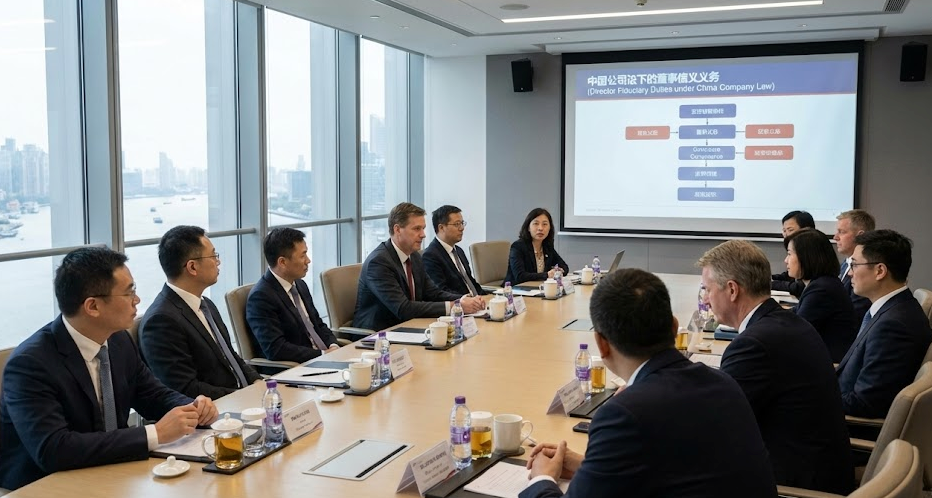
The 2024 Law introduces several specific scenarios where a director’s personal assets may be at risk:
Strategic Protection: The Rise of D&O Insurance
With the expansion of personal liability, the 2024 Company Law also formally introduces Directors and Officers (D&O) Insurance (Article 193).
For foreign directors and local executives alike, negotiating a comprehensive insurance policy into your employment contract is now a standard "must-have."
This insurance can cover legal defense costs and settlement amounts, provided the breach was not intentional.
👉 For more on corporate governance and board structures, visit our section on Corporate Law in China.
FAQs Director Duties China Company Law
Can a foreign director be held liable for a Chinese company's debts?
Generally, no, provided the corporate veil remains intact. However, under the 2024 Law, if a foreign director fails in their statutory duties (e.g., neglecting to oversee capital injection or liquidation), they can be held personally liable to the company or its creditors for the resulting losses.
What is the "Shadow Director" rule in the 2024 Law?
Article 180 extends fiduciary duties to controlling shareholders or actual controllers who do not hold a formal director title but exercise "de facto control." If they instruct a director to perform an act that harms the company, both the controller and the director can be held jointly and severally liable.
Does a director have to verify capital contributions?
Yes. Article 51 makes it a mandatory duty for the board of directors to verify that shareholders have paid their registered capital. If a director fails to issue a written notice of payment (capital call) and the company loses money, that director must compensate the company.
Can a third party sue a director directly in China?
Yes. Article 191 establishes that if a director, through "intentional misconduct or gross negligence," causes damage to a third party (like a creditor or consumer) while performing their duties, they are personally liable along with the company.
How does the 2024 Law change the role of the Legal Representative?
The Legal Representative is no longer restricted to the Chairman or General Manager. Any director who "manages company affairs" can be appointed. However, if that director resigns, they are deemed to have resigned as the Legal Representative simultaneously, simplifying the exit process.
Conclusion
The 2026 era of director duties under the China Company Law demands professionalism and active management. The strategy of appointing "dummy directors" is now legally toxic.
Directors must be active fiduciaries, verifying capital, policing conflicts, and executing liquidations precisely. If you cannot fulfill these duties, resignation is safer than remaining on the board of a non-compliant entity.
Subscribe to receive updates
Subscribe to receive the latest blog posts to your inbox every week.