.jpg)
If you live, work, or run a business in China and receive income from overseas, or if a foreign entity receives income from China, the question of tax residency carries real financial stakes.
The China tax residency certificate is the document that formally establishes your status as a Chinese tax resident, unlocks treaty benefits under China's extensive network of double tax agreements, and satisfies regulatory requirements for cross-border banking and investment.
This guide explains who qualifies, what changed with the April 2025 rule overhaul, and exactly how to apply.
What Is the China Tax Residency Certificate?
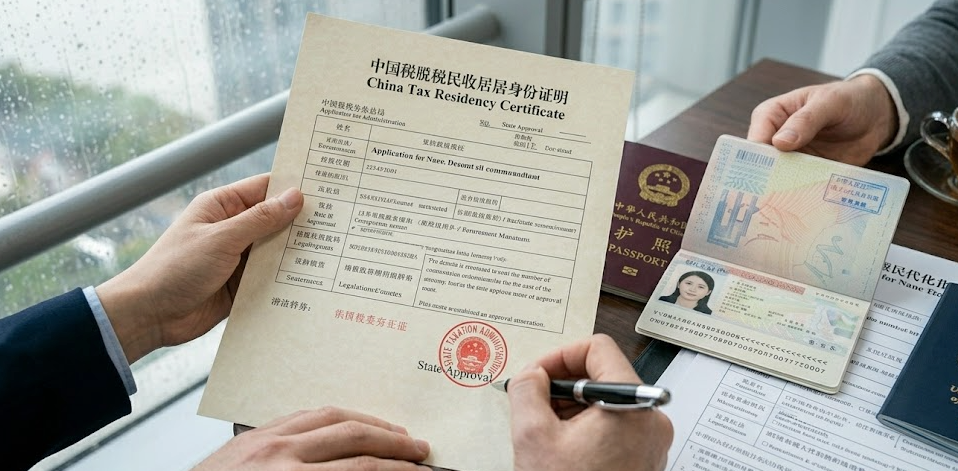
The Certificate of Tax Residency (中国税收居民身份证明) is a formal document issued by the Chinese tax authority that confirms an individual or entity qualifies as a Chinese tax resident for a specific calendar year.
It contains:
- The taxpayer's full name
- The tax identification number (added from April 2025)
- The calendar year covered
- The contracting state or jurisdiction where the certificate is to be used
- Optional partnership information (new from April 2025)
The certificate is issued per calendar year, which runs from January 1 to December 31 in China.
Why do you need it?
The primary purpose is to claim benefits under China's bilateral tax treaties, which now cover over 100 countries and jurisdictions. These treaties typically provide:
- Reduced withholding tax rates on dividends (commonly 5% or 10% instead of the standard rate)
- Reduced rates on interest and royalties
- Exemptions from double taxation on the same income in two countries
Since April 2025, the TRC can also be used for other regulatory purposes without claiming treaty benefits, including opening overseas bank accounts, making outbound investments, and satisfying requirements from foreign immigration or government authorities.
Who Qualifies as a Chinese Tax Resident?
Individuals
An individual is deemed a tax resident in China if they have a domicile in China, or if they have no domicile and have stayed in China for more than 183 days in a tax year.
Two separate tests apply to individuals:
Test 1: Domicile
Domicile refers to habitual residence in China on account of domiciliary registration (hukou), family ties, or economic interests.
A Chinese national with household registration in China is generally considered domiciled in China and is a tax resident regardless of time spent overseas.
For foreign nationals, domicile is assessed based on their permanent address in China, whether immediate family members primarily reside in China, and economic ties such as employment contracts, property ownership, and business interests.
Test 2: The 183-day rule
For foreign nationals and residents of Hong Kong, Macau, and Taiwan without a domicile in China, the critical test is whether they spent 183 days or more in mainland China during the calendar year.
Key points on counting days:
- Each full 24-hour period spent in China counts towards the 183-day threshold. Days of arrival and departure where the stay is less than 24 hours do not count as a full day.
- The count is based on physical presence in mainland China. Days in Hong Kong, Macau, or Taiwan do not count.
- The tax year runs from January 1 to December 31.
The six-year rule for non-domiciled individuals
Foreign individuals who reside in China for 183 days or more in a tax year but not more than six consecutive years are subject to tax on both their China-source income and their foreign-source income paid and/or borne by a China entity or individual.
Foreign individuals who reside in China for 183 days or more per year for over six consecutive years become subject to IIT on their worldwide income from the seventh consecutive year onward.
The six-year count can be reset if the foreign individual spends more than 30 consecutive days outside of China during any tax year, or stays in China for fewer than 183 days in a given year.
Careful travel planning is therefore essential for long-term expats approaching the six-year threshold.
Companies and entities
An entity is deemed a tax resident in China if it is incorporated in China in accordance with Chinese law, or if it is incorporated elsewhere but has its place of effective management (POEM) in China.
Place of effective management refers to an establishment that exercises, in substance, overall management and control over the production and business, personnel, accounting, and assets of the enterprise.
A foreign-incorporated company that holds board meetings in China, has senior management based in China, and makes key business decisions in China may be treated as a Chinese tax resident even without local incorporation.
Table 1: Individual vs. Corporate Tax Residency in China
The April 2025 Rule Changes: What Is New
The State Taxation Administration released STA Announcement No. 4 of 2025 in January 2025.
The Announcement took effect on April 1, 2025, and has made several enhancements regarding TRC application procedures and the issuance of TRCs. It replaced Announcements No. 40 of 2016 and No. 17 of 2019.
The key changes are:
1. Fully digital applications
Applications can now be processed entirely online through the Electronic Taxation Bureau. This eliminates the need for physical visits to tax offices.
For those who cannot or do not wish to use the online channels, in-person services at local tax offices remain available.
2. Reduced processing time
Processing time has been reduced from 10 to 7 working days, provided the tax authority can independently verify the applicant's tax resident status.
If the local tax authority cannot independently determine residency status, it refers the matter to a superior authority and may request supplementary documents; in that case, processing takes up to 20 working days.
3. Expanded application purposes
Previously, the TRC could only be issued for the purpose of claiming tax treaty benefits. From April 2025, applicants can apply under two categories:
- Enjoying agreement treatment: For claiming benefits under a specific tax treaty. Applicants must provide contracts, agreements, board or shareholder resolutions, and relevant payment records.
- Not enjoying agreement treatment: For other regulatory or cross-border purposes such as opening overseas bank accounts, making outbound investments, or satisfying requirements from foreign authorities. Applicants must submit documents verifying the necessity of the certificate.
4. Updated certificate content
- Tax identification number is now included on the certificate
- The requirement for the responsible officer's signature has been removed; verification is now through official seals
- Partnership information can be added as an optional note
5. Clarification for partnerships (first time)
For the first time, the STA has clarified the rules for issuing certificates to domestic partnerships. Domestic partnerships shall apply for certificates through a domestic partner.
The relationship between the partner and the partnership must be indicated under the Taxpayer's Name section in the certificate.
Who Can and Cannot Apply for a Tax Residency Certificate Directly in China

Entities that apply directly
- Chinese resident enterprises (through their registered head office)
- Foreign-incorporated companies are treated as Chinese tax residents (through their head office)
- Individual expatriates who qualify as Chinese tax residents
- Chinese individual citizens who qualify as tax residents
Entities that cannot apply directly
Domestic and foreign branches of Chinese resident enterprises, domestic individual businesses, domestic sole proprietorships, and domestic partnerships cannot directly apply for the China Tax Residency Certificate as they do not have independent legal person status.
The rules for these entities:
- Domestic and overseas branches of Chinese resident enterprises: the Chinese head office applies on their behalf to the head office's competent tax authority
- Individual businesses registered in China: the Chinese resident owner applies to the tax authority where the business is managed and operated
- Sole proprietorships: the Chinese resident investor applies to the tax authority where the business is managed
- Partnerships: a Chinese resident partner applies to that partner's own competent tax authority, with the partnership relationship noted in the certificate
Documents Required for Application
For individuals
- Completed application form for the Certificate of Tax Residency (standard form per STA Announcement No. 4 of 2025)
- Passport copies, along with the original for verification
- Documents evidencing days of residence in China (such as entry and exit records from China's immigration authority)
- For treaty purposes: contracts, agreements, board or shareholders' resolutions, relevant payment receipts, and other supporting documents relating to the income for which treaty benefits are claimed
- For non-treaty purposes: formal documentation verifying the purpose of the application, such as a written request from a foreign bank or regulatory authority
- If the certificate needs to reflect a relationship with an individual business, sole proprietorship, or partnership: corresponding registration documents
For companies
- Completed application form
- Business licence (营业执照)
- Supporting documents for treaty-eligible income, including contracts, agreements, board or shareholders' meeting resolutions, and payment records
- For non-treaty purposes: documents verifying the need for the certificate
- For branches applying through a head office: registration information for both the head office and the branch
If the foreign authority has a specific format requirement:
You must provide a written explanation of that requirement and the required format (in both paper and electronic versions). The Chinese tax authority will handle the application accordingly.
Table 2: Step-by-Step Application Process (Post April 2025)
Practical Uses of the China Tax Residency Certificate
Claiming double tax treaty benefits
China has concluded tax treaties with over 100 countries and jurisdictions, including the US, UK, Germany, France, Australia, Japan, Singapore, and all ASEAN member states.
These treaties typically reduce withholding tax rates on dividends from the standard 10% (or higher) to 5% or 10%, depending on the shareholding threshold. For interest and royalties, treaties may also reduce or eliminate withholding tax.
To access these reduced rates, the Chinese resident (individual or company receiving the income from the other treaty country) must provide the TRC to the paying country's tax authority as proof of Chinese tax residency.
Opening overseas bank accounts
Many overseas banks, particularly in jurisdictions subject to the Common Reporting Standard (CRS) or FATCA, require account holders to provide proof of tax residency. The TRC now satisfies this requirement for Chinese tax residents.
Making outbound investments
Chinese residents making outbound direct investments frequently need to demonstrate their tax residency status to foreign regulatory bodies, investment authorities, or counterparties.
The expanded TRC scope from April 2025 makes it a straightforward document for this purpose.
Immigration and visa applications
Some countries' immigration and work permit systems require applicants to demonstrate their tax status in their country of residence.
The TRC can serve this purpose for Chinese tax residents applying for visas or residence permits abroad.
What the TRC Does Not Do
Several misunderstandings about the TRC are worth addressing directly:
- It is not a certificate of tax compliance. The TRC confirms residency status, not that the applicant has paid all taxes owed in China.
- It does not automatically entitle you to treaty benefits. The TRC itself is not a universal exemption from taxes. Taxpayers need to assess tax residency status in each jurisdiction and analyze the relevant conditions in a specific treaty article, such as beneficial ownership criteria, before assuming treaty benefits apply.
- It does not cover non-treaty purposes automatically. If you need the certificate for a non-treaty purpose, you must specifically apply under the "not enjoying agreement treatment" category and provide supporting documentation for that purpose.
- It is not issued for branches. Branches of Chinese resident enterprises use the head office's TRC.
Conclusion
The Chinese tax residency certificate matters significantly for any expat or multinational with cross-border income. It is the gateway to reduced withholding tax rates under China's extensive double tax treaty network, and since April 2025, it has become a more versatile document for banking, investment, and regulatory compliance outside China.
The April 2025 reforms under STA Announcement No. 4 of 2025 have substantially improved the process: fully digital applications, a 7-working-day turnaround for straightforward cases, and expanded eligibility for non-treaty purposes. The process is now faster and more accessible than ever.
That said, qualifying for the TRC and using it effectively still requires careful assessment. The 183-day count, the six-year rule for non-domiciled individuals, the place-of-effective-management test for companies, and the specific conditions in each applicable tax treaty all require close attention.
For anything beyond a straightforward individual application, professional tax and legal advice before applying will produce better outcomes than correcting errors after the fact.
Frequently Asked Questions
How many days must I spend in China to qualify for a tax residency certificate?
For individuals without a domicile in China, you must have spent 183 days or more in mainland China during the calendar year for which you are applying. Each full 24-hour period spent in China counts towards the threshold. Days where your stay in China is less than 24 hours do not count. Days spent in Hong Kong, Macau, or Taiwan are excluded from this count.
What changed with the April 2025 tax residency certificate rules?
China introduced major updates effective April 1, 2025 under STA Announcement No. 4 of 2025. The reforms enable fully digital applications through the Electronic Taxation Bureau, reduce processing time to 7 working days, and offer flexibility for tax treaty benefits or verification purposes. The certificate now includes the applicant's tax identification number, the signature requirement has been removed, and partnership information can be included as a note. Applications can now also be made for non-treaty purposes such as opening overseas bank accounts or making outbound investments.
Can a company branch apply for a China tax residency certificate?
No. Domestic and overseas branches of Chinese resident enterprises cannot directly apply for the China Tax Residency Certificate as they do not have independent legal person status. The certificate must be applied for by the Chinese head office to the head office's competent tax authority. The branch's name and its relationship to the head office can be noted in the certificate's remarks section.
Is the TRC the same as a certificate of tax compliance?
No. The TRC confirms that an individual or company qualifies as a Chinese tax resident for a specific calendar year. It does not certify that all tax obligations in China have been met or that the applicant is in full tax compliance. It is not a clearance document; it is a residency status document. Using it to claim treaty benefits still requires satisfying the specific conditions set out in the applicable bilateral tax treaty.
Can I apply for a TRC for a past year?
Yes. Enterprises or individuals may apply to the tax authorities in charge for the issuance of the Certificate for any calendar year in which they qualify as Chinese tax residents. The application is not limited to the current calendar year. However, you will need to provide supporting documentation covering the year in question, including proof of days spent in China or documentation supporting corporate residency for that year.
Subscribe to receive updates
Subscribe to receive the latest blog posts to your inbox every week.