Imagine this scenario. It is Friday afternoon. You just got a tip from a whistleblower that your Chinese joint venture partner is quietly moving millions of dollars out of the company bank accounts. They are liquidating assets, selling machinery, and preparing to vanish.
You have a contract with an arbitration clause. In London, New York, or Singapore, you would immediately hire an Emergency Arbitrator. This is a temporary judge appointed within 24 hours to issue a freezing order. In the West, banks and courts respect these orders.
But what happens if the money is in Shenzhen or Shanghai?
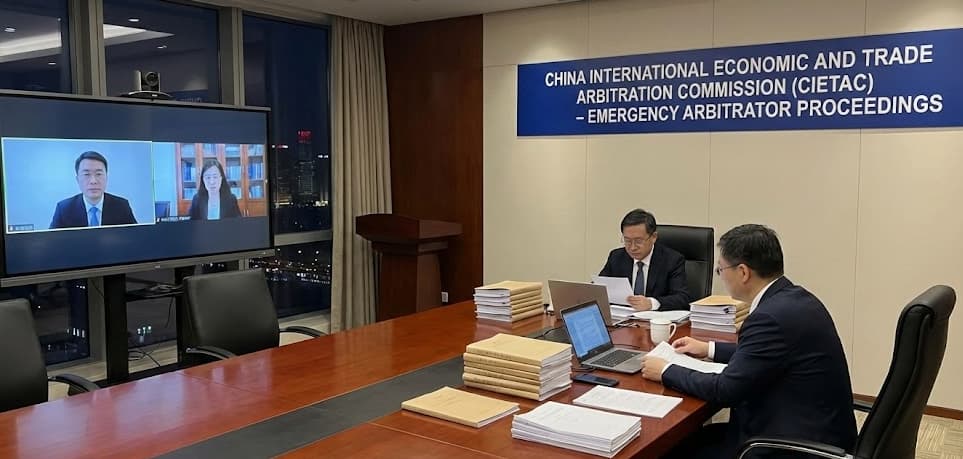
Using an Emergency arbitrator in China is one of the most misunderstood areas of Chinese law. If you follow the Western playbook here, you will fail, and your money will be gone before Monday morning. This guide uses a practical case study approach to show you exactly how to secure your assets before it is too late.
The Key Takeaways
If you are rushing to a meeting with your board of directors, here is what you need to know about emergency arbitration in China:
- In Mainland China, decisions made by an "Emergency Arbitrator" (EA) are generally not directly enforceable by Chinese courts. The courts view asset freezing as their exclusive power.
- Instead of asking an arbitrator, you must apply to the Intermediate People's Court for "Interim Measures" (Property Preservation). This is a court application, not an arbitration award.
- If your arbitration is seated in Hong Kong (e.g., HKIAC), you can use the "2019 Arrangement" to freeze assets in Mainland China directly through the court system. This is often the smartest route for foreign companies.
- The new PRC Arbitration Law (effective March 1, 2026) codifies the right to apply for pre-arbitration relief, but it still keeps the enforcement power with the courts, not the tribunal.
Why Emergency Arbitration in China is Different
To understand the solution, you must understand the blockage. Why does China treat emergency arbitrators differently than the rest of the world?
State Power vs. Private Power
In most countries, arbitration is seen as a full substitute for the court system. If an arbitrator orders you to freeze money, the state backs them up.
In China, the philosophy is different. The power to use "coercive force" (like freezing a bank account or seizing a ship) is considered a sovereign power of the State. It belongs exclusively to the People's Courts.
Chinese law (specifically the Civil Procedure Law) historically does not allow private individuals (arbitrators) to exercise this state power. Therefore, even if a highly respected emergency arbitrator from CIETAC orders your opponent to "stop moving funds," the bank will simply ignore it. The bank manager will say, "Show me a court order with a red stamp."
This creates a dangerous gap. You want arbitration for the final dispute because it is neutral and private. But you need the court for the immediate emergency because only they have the muscle. Bridging this gap is the hardest part of litigation in China.
Emergency Arbitration Case Study
Let's look at two hypothetical foreign companies, TechCorp A and Logistics B. Both are facing the exact same crisis: a Chinese partner is draining the corporate accounts. Both act fast, but they choose different legal paths.
The Failure: TechCorp A (The Western Approach)
TechCorp A has a standard ICC arbitration clause seated in Paris. They trust the international system.
- Day 1: TechCorp A applies to the ICC in Paris for an Emergency Arbitrator.
- Day 3: The ICC appoints a brilliant arbitrator from Switzerland.
- Day 7: After a rushed hearing, the arbitrator issues a gleaming "Emergency Award" ordering the Chinese partner to freeze $10 million.
- Day 8: TechCorp A takes this award to the Intermediate People's Court in Beijing.
- The Result: The Chinese judge rejects it. Why? Because China has not signed any treaty that requires it to enforce "interim orders" from foreign arbitrators. The New York Convention only applies to final awards, not emergency ones. While TechCorp A argues with the judge, the Chinese partner finishes moving the money to an offshore account.
The Success: Logistics B (The "HK Arrangement" Approach)
Logistics B was smarter. Their legal team knew about the special relationship between Mainland China and Hong Kong. Their contract specified HKIAC arbitration seated in Hong Kong.
- Day 1: Logistics B does not wait for an arbitrator. They use the "Arrangement Concerning Mutual Assistance in Court-ordered Interim Measures" (The 2019 Arrangement).
- Day 2: They submit an application to HKIAC. HKIAC acts as a "mailbox." They check the paperwork and forward it directly to the Intermediate People's Court in Shanghai.
- Day 4: The Shanghai judge receives the letter from HKIAC. Because it comes through this official treaty channel, the judge has the power to act immediately.
- Day 5: The judge issues a Civil Ruling to freeze the bank accounts.
- The Result: The bank complies immediately because the order came from a Chinese court with a red stamp. The assets are secured before the Chinese partner even knows what happened.
This case study illustrates why the choice of institution matters. It is not just about convenience; it is about enforcement tools.
👉 Learn more about the different institutions in our guide to Alternative Dispute Resolution in China.
The "Emergency Arbitrator" in Chinese Rules (CIETAC vs. BAC)
You might be confused. If you look at the rulebooks for Chinese institutions like CIETAC (China International Economic and Trade Arbitration Commission) or BAC (Beijing Arbitration Commission), they clearly list rules for "Emergency Arbitrators."
If the courts don't enforce them, why do these rules exist?
Reason 1: Voluntary Compliance
The optimistic view is that the other party will voluntarily obey the arbitrator to avoid looking bad in front of the tribunal. If they ignore the emergency order, the tribunal might view them with suspicion later in the main case.
Reality Check: In fraud cases or asset flight scenarios, the bad actors do not care about "looking bad." They care about keeping the money. Voluntary compliance rarely works against determined thieves.
Reason 2: Foreign Enforcement
If the Chinese company has assets outside of China (for example, a warehouse in Los Angeles or a bank account in London), these rules are very useful. You can get a CIETAC emergency order in Beijing and take it to a New York court. The New York court might enforce it because US law is more flexible about emergency arbitrators.
👉 For a deep dive into the specific rules of the Beijing commission, read our analysis on the Beijing Arbitration Commission (BAC).
The 2026 Arbitration Law: What Changed?

China is currently overhauling its legal framework. On March 1, 2026, the new Revision of the PRC Arbitration Law comes into effect. This is a massive update, but does it fix the emergency arbitrator problem?
Article 49: The Right to Apply
The new law explicitly mentions that parties can apply for "Interim Measures" before or during arbitration. This is a big step forward because it codifies the right.
The "Court Monopoly" Remains
However, the new law stops short of giving arbitrators the power to send in the police. It still says that if an arbitrator grants an interim measure, it must be submitted to the People's Court for enforcement.
So, while the law is getting better, the fundamental mechanism remains the same: The Court is King. You still need a judge to stamp the paper if you want to freeze a bank account in China.
👉 This reinforces the need to understand the broader legal landscape. See our article on 10 Laws in China you should know.
The Winning Strategy: A Step-by-Step Guide
If you are facing an emergency in China today, do not waste time seeking a "paper tiger" decision from an arbitrator that you cannot enforce. Follow this "Dual-Track" process used by experienced litigators.
Step 1: File for Arbitration Immediately
You cannot get interim measures without a main case. You need to file the "Notice of Arbitration" and pay the filing fee. This proves to the court that a real legal dispute exists.
Step 2: Prepare the "Property Preservation" Application
This is a court document, not an arbitration document. It needs to be written in Chinese and follow strict court formatting. You must identify the assets clearly. You cannot just say "freeze all their money." You need bank account numbers or real estate addresses.
Step 3: The "Security" (Dan Bao)
This is where most foreign companies get stuck. The Chinese court will say: "If we freeze this money and it turns out you are wrong, who pays for the damage?"
They require you to post security. This usually means:
- Cash: Transferring cash equal to 30% to 50% of the value you want to freeze into the court's account.
- Bond: Buying a "Litigation Property Preservation Liability Insurance" bond from a Chinese insurance company. This is much cheaper than cash (usually 0.5% of the claim value) and is the preferred method today.
Step 4: The "Mailbox" Route
You cannot walk into the court yourself if you have an arbitration agreement. You must go through the institution.
- If using CIETAC/BAC: Submit the application to the commission. They will stamp it and mail it to the court.
- If using HKIAC (Hong Kong): Submit to HKIAC. They will issue a "Letter of Acceptance" and forward it to the Mainland court under the 2019 Arrangement.
Comparison of Options
Here is a quick comparison table to help you decide which path to take.
Conclusion
The term "Emergency Arbitrator" is a bit of a trap in the Chinese context. It sounds powerful, but it often lacks teeth. While the rules exist on paper, the People's Court holds the keys to the castle.
If your strategy relies on an arbitrator issuing an order from a conference room in London or Singapore, you will likely lose your assets. The winning strategy in 2026 is to use the court-assisted preservation mechanisms, specifically, the Hong Kong-Mainland Arrangement or the domestic preservation protocols.
Remember, arbitration in China is a hybrid creature. It is private dispute resolution, but it is tightly hugged by the public court system. To win, you need to know how to dance with both.
Final Thought: Speed is your only leverage in an asset flight scenario. Do not let procedural confusion slow you down. By the time you figure out the rules, the money might already be in an offshore trust.
FAQs: Emergency Arbitrator in China
Can I enforce a Singapore (SIAC) Emergency Arbitrator decision in China?
Generally, no. Mainland Chinese courts do not recognize "interim orders" from foreign tribunals under the New York Convention. The Convention only covers "final awards." You would need to apply to the Chinese court directly for preservation. This is difficult for foreign-seated arbitrations unless you are using the Hong Kong arrangement.
How much does it cost to freeze assets in China?
The court application fee itself is very small, capped at 5,000 RMB (about $700). The real cost is the security. You must provide collateral to cover any damages to the respondent if your claim turns out to be wrong. Most companies use an insurance bond for this, which costs about 0.5% to 1% of the amount you want to freeze.
What is the "HK-Mainland Arrangement"?
This is a special treaty signed in 2019. It allows parties in arbitrations seated in Hong Kong (and administered by approved institutions like HKIAC or ICC-HK) to apply directly to Mainland Chinese courts for interim measures. It is currently the only reliable way for an offshore arbitration to freeze onshore Chinese assets.
Does the new 2026 Arbitration Law allow "Ad Hoc" emergency arbitration?
The new law allows "Ad Hoc" arbitration (arbitration without an institution) in limited zones like Free Trade Zones for foreign disputes. However, requesting emergency relief in an ad hoc setting is legally complex and untested. Institutional arbitration (CIETAC/SHIAC) remains much safer for emergency scenarios because the courts are used to dealing with them.
Do I need a Chinese lawyer to file these applications?
Yes. Arbitration allows foreign lawyers to represent you, but court applications in China (like property preservation) must be handled by a licensed PRC lawyer. A foreign lawyer may not appear before a Chinese court or submit court documents in their own name.
Subscribe to receive updates
Subscribe to receive the latest blog posts to your inbox every week.