If you have lived or worked in China and are now applying for immigration, employment overseas, or a visa in a third country, you will almost certainly need a China police clearance certificate.
Unlike most countries, China issues only a certificate covering the time you resided in a specific city, so if you have lived in multiple locations, you may need multiple certificates.
This guide covers the full process for 2026, including the key changes from the November 2023 apostille shift, the June 2025 e-apostille launch, and the November 2025 Nanjing rule update.
What Is It Called and Why Is It Needed?
The document has several names.
All refer to the same thing:
- Certificate of No Criminal Record (无犯罪记录证明) — the official Chinese name
- No Criminal Record Certificate (NCR)
- Police Clearance Certificate (PCC)
- China Police Certificate
You will typically need it when:
- Applying for permanent residency or citizenship abroad (Canada, Australia, US, UK, New Zealand)
- Renewing or upgrading a Chinese work visa
- Applying for admission to a university or professional program overseas
- Registering a marriage abroad
- Applying for a professional licence in another country
Who Can Apply for a Police Clearance Certificate in China?
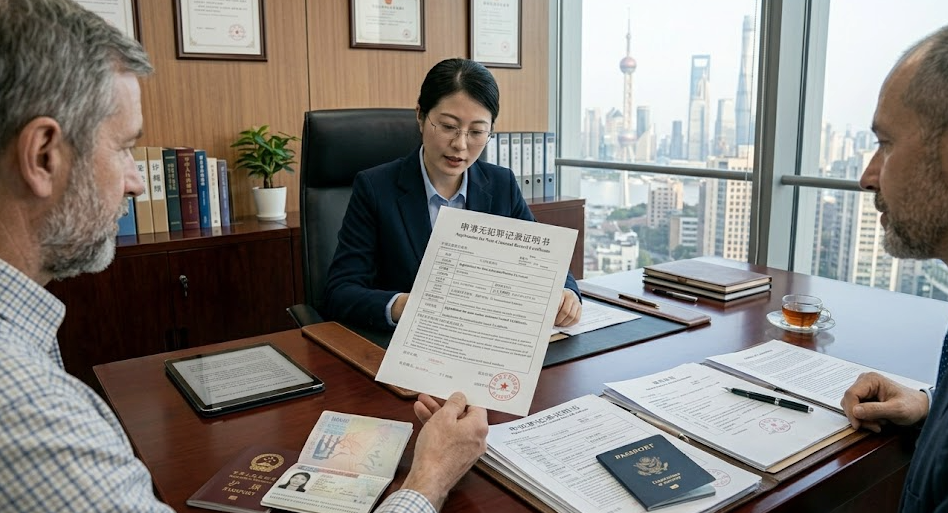
Basic eligibility
To qualify in most Chinese cities, you must meet all of the following at the same time:
- You held a valid long-term residence permit (work, study, or family reunion) in the city where you are applying
- You legally resided in China for 180 days or more on that permit
- You registered your address with the local police station during your stay
- You have no criminal record during the period in question
Who cannot apply
- Diplomatic and official passport holders cannot obtain this certificate
- People who stayed on tourist (L) or short-term business visas with no residence permit
- Anyone who stayed for less than 180 consecutive days in the city, even if multiple visits add up to more than that
- People who never completed the Temporary Residence Registration during their stay
Multiple city rules
If you lived in Beijing and Shanghai for one year each, you would need to apply for two separate certificates, one in Beijing and one in Shanghai.
There is no national authority that can issue a single certificate covering all of China. Apply separately in every city where you held a residence permit and lived for 180 days or more.
Chinese Police Clearance Certificate: Key Changes to Know
Three developments have changed the process since 2023, and every applicant needs to understand them before starting:
1. China joined the Hague Apostille Convention (November 7, 2023)
For most destination countries, the old multi-step process (notarisation + MFA authentication + embassy legalization) has been replaced by a simpler two-step process (notarisation + MFA apostille).
This applies to all Hague Convention member countries. For non-member countries such as Vietnam, Malaysia, and parts of the Middle East, the older consular legalization route still applies.
2. China launched the e-Apostille pilot (June 18, 2025)
As of June 18, 2025, China launched a pilot electronic apostille system. The first document type to be apostilled digitally was the Certificate of Origin issued by the China Council for the Promotion of International Trade.
The pilot operates entirely online and plans to extend to other public documents in the future. Police clearance certificates are not yet covered under the e-apostille system, so physical notarisation and apostille remain required for now.
Monitor the MFA consular services website for updates as the program expands.
3. Nanjing rule changes (November 2025)
As of November 2025, the Temporary Residence Registration Form is no longer a mandatory requirement in Nanjing. However, an official request from the immigration authority confirming the China PCC is required is now mandatory for Nanjing applications from that date.
If you are applying for a Nanjing certificate, make sure you have the official written request from the immigration body asking for the certificate — without it, your application will not be accepted.
Documents Required for Police Clearance Certificate
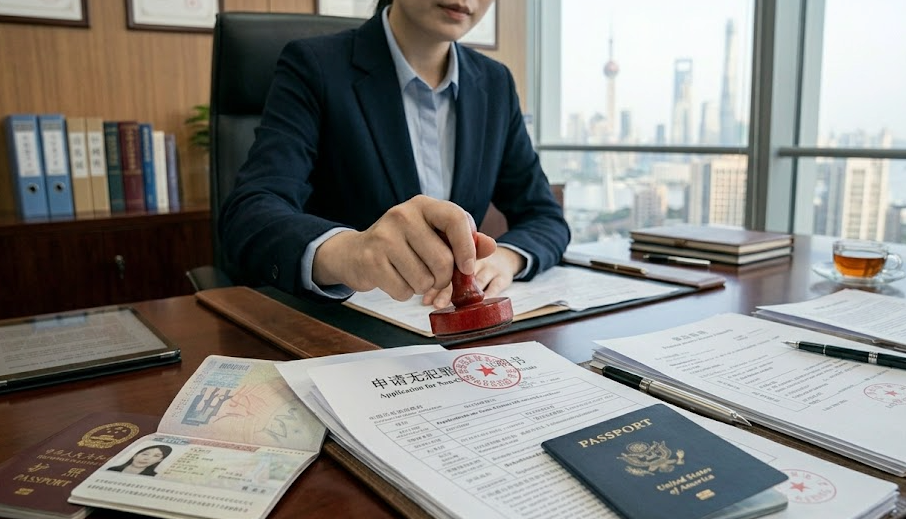
Requirements vary city by city. The following is a reliable baseline, but you must confirm with the local PSB or a specialist agent before submitting.
Required in almost all cities:
- Valid passport, including all pages showing Chinese visas, residence permits, and entry/exit stamps
- Previous passports used during your stay in China, if applicable
- Completed application form (available at the PSB or downloadable from the Ministry of Public Security website)
- Foreigner Temporary Accommodation Registration Form (TRRF), obtained from the local police station where you registered your address
- Power of Attorney with the agent's valid ID, if applying through a representative
Depending on your visa type:
- Work permit or employment contract (Z visa/work residence permit holders)
- Diploma, degree certificate, or official enrolment letter (X1 student visa holders)
- Good conduct letter from your employer or university (required in some cities, optional in others)
If you changed passports during your stay:
- Copies of both the current and all expired passports that covered your time in China
If your passport is lost:
- A written declaration explaining the loss, including the reason, passport issuance and expiry dates, date of loss, and a police report number if one was filed
- Some cities will proceed on this basis; others will deny the application
3 Steps for China Police Clearance Certificate
Step 1: Obtain the certificate from the PSB
- Confirm eligibility and gather all required documents
- Submit to the Entry-Exit Administration Bureau at your local PSB in the city where you reside
- The PSB checks your record and issues the Certificate of No Criminal Record
- Processing time: 5 to 7 working days in most cities
- You or your authorized representative can collect the certificate in person
- The raw certificate is valid for 3 months from issue — get it notarised before it expires
Shanghai is a special case. In Shanghai, foreigners apply directly to a local notary office rather than the PSB. The notary office submits an online check to the Shanghai High People's Court and issues the certificate based on the result.
Going to the PSB directly in Shanghai will result in you being redirected to the notary office. The Shanghai Oriental Notary Office has the most experience with foreign applicants.
Step 2: Notarisation
The raw PSB certificate is not accepted internationally in its original form. Take it to a Chinese notary public office for official notarisation and translation.
- The notarised document is bilingual: Chinese and English (or another language on request)
- Notarisation processing time: approximately 7 working days, not including mailing time
- Some cities have only a small number of notary offices experienced with foreign applicants — ask locally or use a specialist agent to identify the right one
Step 3: Apostille or consular legalization
Once notarised, the level of authentication depends on your destination country.
For Hague Convention countries (Australia, Canada, US, UK, Germany, France, New Zealand, UAE, etc.):
- Take the notarised certificate to the Ministry of Foreign Affairs regional office (or local Foreign Affairs Office, FAO) for an apostille
- Standard processing: 4 to 5 working days; express service: 2 to 3 working days
- The apostille fee is ¥50 RMB per document; express service adds a further ¥50 RMB
- You cannot apply for an apostille at an FAO for a document issued in a different province — the document and the FAO must be in the same jurisdiction
- Verify any Chinese apostille online at: https://consular.mfa.gov.cn/VERIFY
For non-Hague Convention countries (e.g. Vietnam, Malaysia, Saudi Arabia, some others):
- Notarisation at a Chinese notary public office
- Authentication at China's Ministry of Foreign Affairs
- Legalisation at the destination country's embassy or consulate in China
Table 1: China Police Clearance Certificate at a Glance (2026)
Applying from Outside China
If you have already left China, you do not need to return. Most cities allow a representative to apply on your behalf.
Option 1: Appoint a representative in China
- A representative can pursue your certificate on your behalf through a signed Power of Attorney. You send over your scanned documents, the agent handles the in-person legwork, and the certificate is couriered to you.
- Depending on the city, the Power of Attorney may need to be notarised in your country of residence and then apostilled or legalised before it is accepted in China
- A friend, family member, or professional agency can act as your representative
Option 2: Use a specialist agency
Several agencies operate specifically in this space. They receive your documents by email, handle the full PSB and notarisation process on the ground in China, and ship the completed authenticated certificate to you via DHL or FedEx.
If the certificate is unobtainable:
Some applicants cannot qualify because they lacked a residence permit, never registered their address, or stayed for less than 180 days. In these cases:
- Request a formal letter from the Chinese authorities confirming the certificate cannot be issued
- Canada requires that an applicant show proof that they requested a police certificate from the correct authorities and explain why it cannot be issued
- The US, Australia, and New Zealand have similar provisions for alternative evidence
- A lawyer or specialist agent can prepare a formal waiver request for submission to the relevant immigration body
City-Specific Notes for 2026
Beijing:
Applications go to the Exit-Entry Administration Bureau of the Beijing Municipal PSB. Processing is typically 5 to 7 working days.
The two-step process applies: PSB first, then notarisation at the Beijing Fangyuan Notary Public Office or another licensed notary.
Shanghai:
Foreigners apply directly to a local notary office, which submits the check to the Shanghai High People's Court online.
Not all Shanghai notary offices handle foreign applicants well; the Shanghai Oriental Notary Office is the most experienced.
Shenzhen:
Applications go to the Shenzhen Municipal Administrative Service Hall. Foreigners with a work, study, or journalist visa who resided for more than 6 months and completed residence registration are eligible.
Nanjing (updated November 2025):
As of November 2025, the TRRF is no longer mandatory, but an official request from the immigration authority confirming the PCC is required is now a mandatory submission document.
Processing takes 10 to 15 working days for the notarised PCC with English translation.
All other cities:
Contact the local PSB Entry-Exit Administration office directly or use the National Immigration Administration's 12367 hotline to confirm current requirements.
Rules change without much notice, and published information can be out of date quickly.
Common Mistakes and How to Avoid Them
- Applying in the wrong city. The certificate covers only the city where your residence permit was issued. A Beijing certificate does not cover your time in Guangzhou.
- Never register your address. If you did not register at the local police station within 24 hours of arriving, you may not have a TRRF. Without it, some cities will reject your application outright.
- Letting the raw certificate expire. The PSB certificate is valid for 3 months. If you miss the notarisation window, you must start again.
- Assuming one apostille format suits all countries. Spain and Italy, despite being Hague members, sometimes require embassy legalization on top of the apostille for specific visa categories. Confirm the requirement with the body asking for the document.
- Preparing the wrong Power of Attorney format. Requirements differ by city. An incorrectly drafted or unauthenticated POA will be rejected.
- Applying too close to the submission deadline. Many countries require the PCC to have been issued within 6 months of submission. The whole process takes 2 to 4 weeks, sometimes longer. Plan at least 6 to 8 weeks ahead.
- Assuming Nanjing rules are the same as before. The November 2025 changes mean some documents are no longer required and a new one has been added. Do not rely on guides written before late 2025 for Nanjing applications.
Conclusion
Getting a Chinese police clearance certificate in 2026 is a manageable process, but it requires understanding how the system works. The key points to get right:
- Identify every city where you lived for 180 days or more on a residence permit, and apply separately in each
- Get the raw certificate notarised before the 3-month validity window closes
- Confirm whether your destination country needs an apostille, full consular legalization, or both
- If applying from abroad, prepare a properly notarised and authenticated Power of Attorney
- If you lived in Nanjing, be aware that the rules changed in November 2025
- If the certificate is completely unobtainable, prepare a formal waiver request with supporting evidence
If your situation involves multiple cities, missing documents, expired passports, or gaps in your residence registration, professional legal or agency help will save you significant time and prevent costly rejections.
FAQs About China Police Clearance Certificate
Do I need a separate China police clearance certificate for each city I have lived in?
Yes. China only issues a certificate covering the time you resided in a specific city. If you have lived in multiple locations, you may need multiple certificates. There is no national authority that issues a single certificate covering all of China. Apply in each city where you held a residence permit and lived for 180 consecutive days or more.
Can I get the certificate if I am no longer in China?
Yes. Most cities allow you to appoint a representative using a Power of Attorney. You send scanned documents to the agent, they handle the in-person legwork, and the certificate is couriered to you. The POA typically needs to be notarised in your current country of residence and then apostilled or legalized before your representative can use it in China.
Does China issue apostilles on police clearance certificates in 2026?
Yes, physical apostilles are available. China joined the Hague Apostille Convention on November 7, 2023. China launched a pilot electronic apostille system in June 2025, starting with commercial documents, with plans to extend to other document types in the future. Police clearance certificates still require a physical apostille for now. The MFA standard processing time is 4 to 5 working days at ¥50 per document, with express service available in 2 to 3 working days for an additional ¥50.
What changed in Nanjing in November 2025?
From November 2025, the Temporary Residence Registration Form will no longer be mandatory in Nanjing. However, an official request from the immigration authority confirming the PCC is required is now a mandatory document for Nanjing applications. Applicants using older process guides for Nanjing may find their document checklist is outdated.
What if I cannot get the certificate at all because I have no residence permit?
Request a formal letter from the Chinese authorities confirming that the certificate cannot be issued. Canada requires that an applicant show proof that they requested a police certificate from the correct authorities and explain why it cannot be issued. Australia, New Zealand, the US, and most other destination countries have similar provisions. A lawyer or specialist agent can prepare a formal waiver request addressed to the relevant immigration body on your behalf.
Subscribe to receive updates
Subscribe to receive the latest blog posts to your inbox every week.