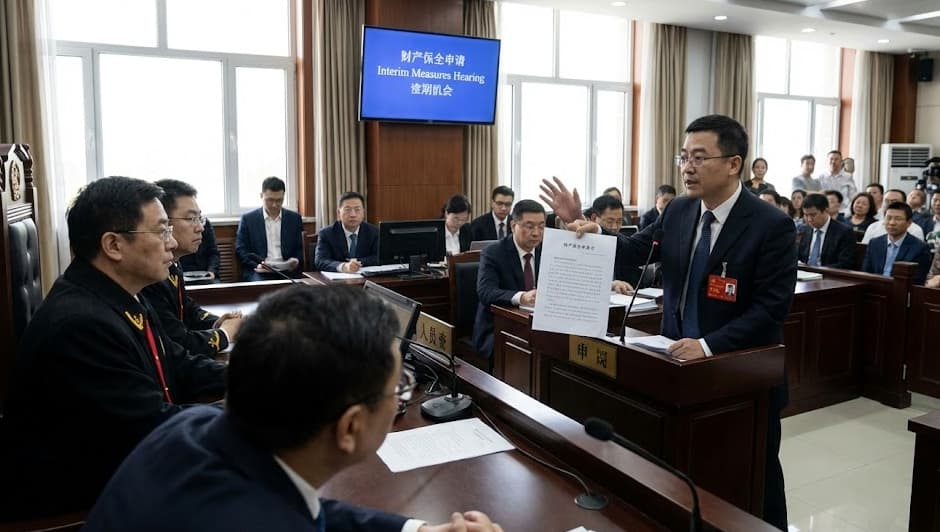
Imagine this scenario. You spend two years fighting a difficult lawsuit in Beijing. You hire the best lawyers. You fly in witnesses. You finally win the case. The judge slams the gavel and awards you $5 million in damages.
You go to the bank to collect your money, but the account balance is zero. The defendant's factory has been sold. The equipment is gone. They moved everything while you were busy arguing in court.
This is the most common "tragedy" for foreign companies doing business in China. Winning the legal argument is completely useless if the money is gone. This is why interim measures in Chinese courts are the single most powerful weapon in your legal arsenal.
Unlike in some Western countries, where "injunctions" are very hard to get, Chinese courts are actually quite willing to freeze assets. But you have to follow their strict rules. This guide explains exactly how to lock down your money before it vanishes.
The Quick Takeaways
If you suspect your Chinese partner is moving money offshore, you need to act fast. Here is how asset freezing works in 2026:
- It is called "Preservation": In China, we do not say "injunction." We say "Property Preservation" (freezing assets) or "Behavior Preservation" (stopping an action).
- Pay to Play: You cannot just ask a judge to freeze an account. You must provide "Security" (collateral). This is usually an insurance bond costing about 0.5% of the claim value.
- Speed is Key: Once the court accepts your application and security, they must issue a ruling within 48 hours.
- Surprise Attack: The court will not warn the other party. They freeze the money first, then notify the defendant.
- Hong Kong Advantage: If you arbitrate in Hong Kong, you can use a special treaty to freeze assets in Mainland China. This is a unique superpower.
What Are "Interim Measures" in China?
In the West, you might ask for a "Mareva Injunction" or a "Temporary Restraining Order." In China, we rely on the China Civil Procedure Law (CPL). The law divides these measures into three distinct types. You need to know which one to ask for.
Type 1: Property Preservation (The Big One)
This is what 95% of businesses need. It effectively freezes the defendant's assets so they cannot be sold or transferred.
What can be frozen?
- Bank Accounts: The most common target. The court orders the bank to stop any outgoing transfers. Money can come in, but it cannot go out.
- Real Estate: The court puts a "seal" on the property title at the local housing bureau. The owner can still live there or work there, but they cannot sell it or mortgage it.
- Equity/Shares: If your partner owns shares in a Chinese company, the court can freeze those shares. This stops them from selling their stake or receiving dividends.
- Inventory/Equipment: The court can physically seize goods or seal machinery with official court tape.
Type 2: Behavior Preservation (Conduct)
This orders someone to do something or to stop doing something. It is similar to a Western "injunction."
Examples:
- Ordering a factory to stop using your patented technology immediately.
- Ordering a former employee to stop contacting your clients.
- Ordering a shareholder to stop holding an illegal board meeting.
Type 3: Evidence Preservation
Sometimes the asset isn't money. Sometimes the asset is the proof itself. If you think the defendant is about to shred documents or delete hard drives, you can ask the court to seize the evidence.
Common uses: Intellectual property theft cases where the software code is on a server that might be wiped.
The "Security" Hurdle: You Must Pay to Freeze
This is where most foreign clients get stuck. They ask, "Why do I have to pay to freeze their money?"
Here is the logic. The Chinese judge is thinking: "If I freeze this factory's bank account today, they might go bankrupt next week. They cannot pay their workers. They cannot buy raw materials. If it turns out later that the plaintiff was wrong, who is going to pay for the factory's lost business?"
To protect the defendant from wrongful freezing, the court requires you (the applicant) to provide Security (called "Dan Bao" in Chinese).
The Old Way: Cash Deposit
In the past, you had to deposit cash equal to 30% or even 100% of the value you wanted to freeze. If you were suing for $10 million, locking up $3 million in a court account for two years was impossible for most companies. This rule stopped many foreign companies from using interim measures.
The New Way: Insurance Bonds
Today, almost everyone uses "Litigation Property Preservation Liability Insurance." This has revolutionized litigation in China.
How it works:
- You approach a Chinese insurance company (like PICC, Ping An, or CPIC).
- You show them your lawsuit and your evidence.
- You pay a small premium (usually 0.2% to 0.8% of the claim amount).
- The insurance company issues a "Guarantee Letter" to the court.
- The court accepts this letter as full security.
Why this matters: Instead of tying up millions in cash, you pay a few thousand dollars in premiums. This makes interim measures affordable for standard contract disputes in China.
Timing: Pre-Litigation vs. During Litigation
You can pull the trigger at two different times. Choosing the right moment is a critical strategic decision.
Scenario A: Pre-Litigation Preservation (The Emergency)
You have not filed the lawsuit yet. Maybe you are still gathering evidence. But suddenly, you get a tip that your partner is selling off assets. You need to act now.
You can apply for an emergency freeze before filing the case. However, the rules are stricter:
- Urgency: You must prove that the situation is urgent and that you will suffer "irreparable damage" if the court doesn't act immediately.
- The 30-Day Rule: Once the court freezes the assets, the clock starts ticking. You must file the official lawsuit or arbitration within 30 days. If you miss this deadline, the court unlocks the assets immediately.
- Higher Security: Courts often demand higher security for this because the case hasn't been formally reviewed yet.
Scenario B: Litigation Preservation (The Standard)
This is the most common path. You file your lawsuit and the preservation application on the same day (or a few days apart).
This is the "one-two punch." The defendant receives the court summons and realizes they are being sued. At the exact same moment, their bank accounts freeze. This puts immense pressure on them to settle the case quickly.
Special Rules for Arbitration
Many international contracts require arbitration instead of going to court. Can you still freeze assets if you have an arbitration clause? Yes. But it is a two-step dance.
The Problem: Arbitrators are private judges. They do not have state power. An arbitrator cannot order a bank to freeze an account. Only a state court judge can do that.
The Solution: If you are in commercial arbitration in China (e.g., at CIETAC), you submit your application to the arbitration commission. They review it, stamp it, and mail it to the relevant court for you. You cannot walk into the court yourself; you must go through the arbitration commission.
The "Hong Kong Exception"
This is a massive advantage for foreign companies. Historically, if you arbitrated outside of Mainland China (like in London or Singapore), you could NOT freeze assets in China. The Chinese courts would not help you.
However, since 2019, there is a special arrangement between Mainland China and Hong Kong. If your arbitration is seated in Hong Kong (and administered by an approved institution like HKIAC), you can apply to Mainland Chinese courts for interim measures.
This makes Hong Kong the best place to resolve disputes involving Chinese assets. You get the neutrality of Hong Kong law plus the enforcement power of Mainland courts.
The "48-Hour" Rule & Execution
Chinese law is strict about speed. According to the Civil Procedure Law, once the court accepts your application and verifies your security, the timeline is tight.
The Ruling
The judge must issue a ruling within 48 hours if the situation is deemed urgent. In practice, almost all property preservation cases are treated as urgent.
The Execution
Issuing the ruling is just paperwork. The real work is execution.
- Bank Accounts: This is fast. Chinese courts have a digital system linked to most major banks. The judge clicks a button, and the account is frozen instantly.
- Real Estate: This is slower. Two court officers (bailiffs) usually have to drive to the local real estate bureau to file the paperwork in person.
- Equipment: This requires a physical trip to the factory to apply the seals.
The Surprise Element: This is crucial. It is an ex parte process. The court does not hold a hearing. They do not call the defendant to ask for their side of the story. If they did, the defendant would move the money. The court freezes the assets first, and then notifies the defendant.
How to Find the Assets (Investigation)
The court will not be your detective. You cannot just say, "Freeze all their money." You need to tell the court exactly what to freeze.
You typically need to provide:
- Bank Accounts: The exact account number and the bank branch name.
- Real Estate: The exact address and property certificate number.
How do you get this info?
- Prior Payments: Check your past invoices and bank slips. Where did you send money to them? That is their bank account.
- Lawyer Investigation: A licensed Chinese lawyer can use their "Investigation Order" to look up corporate records and sometimes real estate holdings.
- Credit Reports: Commercial credit reports can sometimes list major assets.
If you have no idea where the assets are, you can ask the court to issue a general freeze order against the company name, but this is less effective because the court system might not catch every obscure bank branch.
Common Pitfalls and Mistakes
Even with a good case, applications get rejected. Here is why.
1. Insufficient Security
If your insurance bond doesn't cover the full amount or comes from an unapproved insurer, the court will reject it. Always use a major insurer.
2. Wrong Court Jurisdiction
You generally apply to the court where the assets are located or where the defendant lives. If the factory is in Shenzhen but you apply to a court in Beijing, they will bounce your application.
3. "Excessive" Seizure
If you are suing for $1 million, you cannot freeze a factory building worth $50 million. That is considered "excessive." The court will ask you to find a smaller asset, or they will freeze the building but allow the defendant to keep using it (just preventing the sale).
Conclusion
Interim measures in Chinese courts are efficient, powerful, and absolutely necessary for asset recovery. The system is designed to favor the swift. If you sit back and wait for the final judgment to start looking for assets, you will likely find nothing but an empty shell company.
The key to success is preparation. Before you even file the lawsuit, you should have your asset list ready, your insurance bond budget approved, and your lawyer ready to sprint to the court.
Final Thought: Do not treat "Property Preservation" as an optional add-on. In China, it is often the step that forces a settlement. When the cash flow stops, the negotiation starts.
FAQs: Interim Measures in Chinese Courts
Can I freeze assets before filing a lawsuit?
Yes. This is called "Pre-litigation Property Preservation." However, it is strictly for emergencies. You must prove that you will suffer irreparable damage if the court doesn't act immediately. Crucially, you must file the official lawsuit or arbitration within 30 days after the freeze, or the assets will be released.
How much does it cost to apply for interim measures?
There are two main costs to consider. First is the Court Application Fee, which is surprisingly cheap. It is capped at 5,000 RMB (about $700 USD) regardless of the claim size. Second is the Security (Bond). If you use an insurance bond, expect to pay a premium of about 0.5% of the total amount you want to freeze. If you want to freeze $1 million, the insurance might cost you $5,000.
Can I freeze a company's bank account completely?
The court will freeze the value you claim, not necessarily the whole account. If you claim $1 million and the account has $5 million in it, the court freezes $1 million. The company can still use the remaining $4 million. However, if the account only has $500,000, the court freezes the entire balance and any future money that comes in until it hits the $1 million cap.
Will the court tell the defendant before freezing the assets?
Generally, no. The element of surprise is crucial. If the court held a hearing first, the defendant would simply move the money. The court usually freezes the assets first and then sends the notification to the defendant a few days later.
What if the frozen assets belong to a third party?
This happens sometimes. If the court accidentally freezes a car that belongs to the defendant's wife (who is not involved in the case), she can file an "Objection to Execution." She needs to show proof of ownership. The court will hold a mini-hearing to decide if the asset should be released.
About the Author: The dispute resolution team at Choi & Huang specializes in asset recovery, commercial litigation, and enforcing foreign judgments in China. We have successfully secured preservation orders in over 20 provinces.
Subscribe to receive updates
Subscribe to receive the latest blog posts to your inbox every week.